
What Is the Solar Wind?
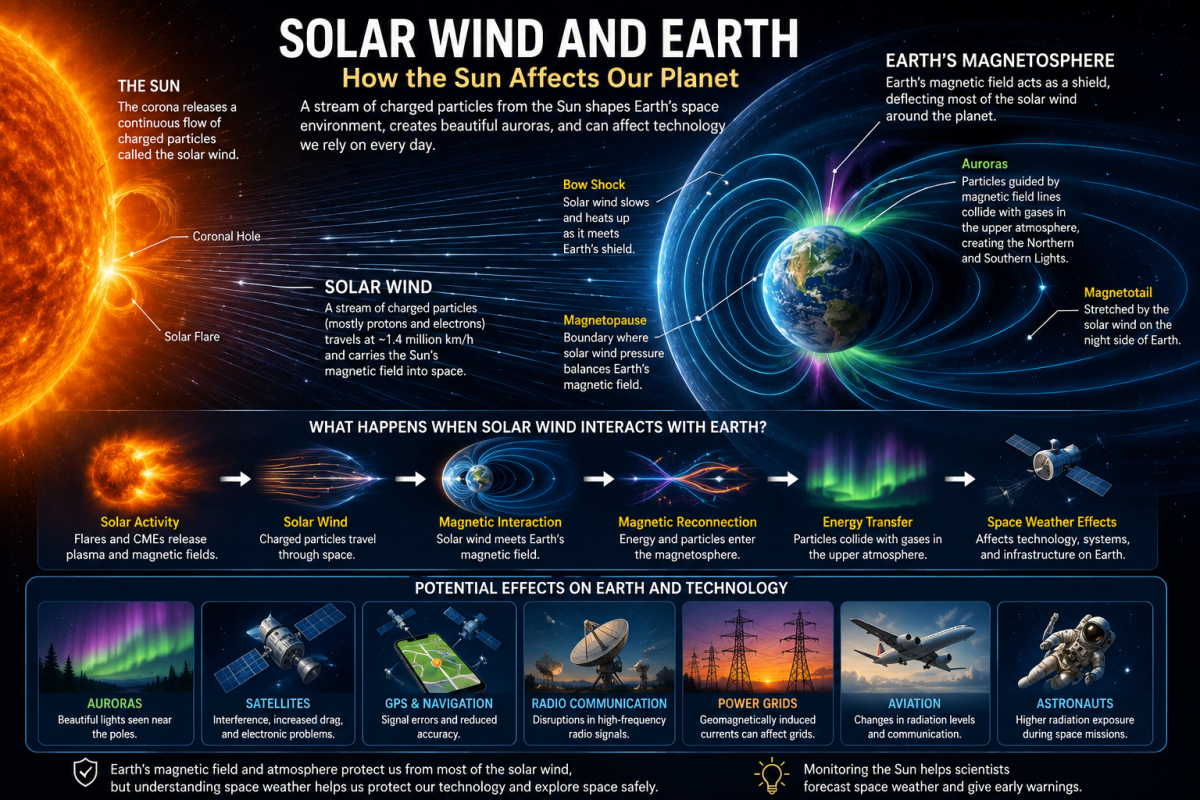
The solar wind is a continuous flow of electrically charged particles moving outward from the Sun. It consists mainly of protons and electrons and carries part of the Sun’s magnetic field into interplanetary space. Near Earth, the solar wind typically travels at roughly 1.4 million kilometers per hour, although its speed can vary considerably.
The solar wind comes from the Sun’s hot outer atmosphere, the corona. Different regions of the corona can produce solar wind with different speeds and densities. Coronal holes are an important source of faster solar-wind streams.
Your article’s basic science can be understood through one simple chain:
Sun → solar wind → Earth’s magnetic field → magnetosphere → upper atmosphere → space weather
That relationship is also central to the JMCCanneyScience research framework, which places the Sun-Earth Connection among its broader space-science topics.
Does Solar Wind Reach Earth?
Yes. The solar wind constantly flows past Earth.
But it does not normally strike Earth’s surface directly.
Earth has a large region of space dominated by its magnetic field called the magnetosphere. This magnetic environment deflects most of the solar wind around the planet. The atmosphere provides another important layer of protection.
A useful way to picture the system is:
Solar wind → magnetosphere → upper atmosphere → limited particle entry
This is why Earth can live under a continuous stream of charged particles without the solar wind simply sweeping away our atmosphere or exposing the surface to all of its energy.
How Does Earth’s Magnetosphere Protect Us?
Earth’s magnetic field creates the magnetosphere, a vast protective region around our planet.
The solar wind compresses the side of the magnetosphere facing the Sun. On the nightside, the magnetic field stretches far outward into a long magnetotail. ESA’s 2026 anatomy of the magnetosphere identifies the major regions involved, including the bow shock, magnetopause, polar cusps, and magnetotail.
The sun-facing boundary, called the magnetopause, forms where the pressure of the solar wind balances the pressure of Earth’s magnetic field. The dayside magnetosphere typically extends about 6–10 Earth radii from the planet, although its shape changes continuously with solar-wind conditions.
Think of the magnetosphere less as a solid wall and more as a dynamic magnetic shield.
It can bend, compress, stretch, reconnect, and release energy as the solar wind changes.
What Happens When Solar Wind Interacts With Earth’s Magnetic Field?
The interaction is not always gentle.
The solar wind carries the interplanetary magnetic field, which can interact with Earth’s magnetic field. When the fields have the right orientation, magnetic reconnection can occur.
Magnetic reconnection allows energy and some charged particles from the solar wind to enter the magnetosphere more effectively. That transferred energy can drive disturbances throughout near-Earth space.
The process can be summarized as:
Solar wind → magnetic interaction → reconnection → energy transfer → magnetospheric activity
This is one of the key processes behind space weather.
How Does Solar Wind Cause Auroras?
Auroras are one of the most beautiful visible effects of the Sun’s interaction with Earth.
During disturbed conditions, some charged particles can travel along Earth’s magnetic field lines toward the polar regions. When these energetic particles interact with gases in the upper atmosphere, they transfer energy to atmospheric atoms and molecules. As those particles return to lower-energy states, they emit light.
The result is the aurora borealis, or Northern Lights, and the aurora australis, or Southern Lights.
Oxygen can produce prominent green and red emissions, while nitrogen contributes blue and purple colors under certain conditions.
That means the aurora is not simply light coming from the Sun.
It is a visible consequence of an interaction between:
Solar particles + magnetic fields + Earth’s upper atmosphere
What Is Space Weather?
Space weather describes changing conditions in near-Earth space caused largely by solar activity and its interaction with Earth’s magnetic environment.
It includes events and disturbances such as:
solar-wind variations
geomagnetic storms
magnetospheric substorms
solar-particle events
effects on the ionosphere and thermosphere
The effects can extend well beyond the aurora.
ESA notes that space weather can affect satellites, astronauts, communications, navigation systems, and electrical infrastructure.
For JMCCanneyScience readers, this connects naturally with the site’s Research Topics, which includes the Sun-Earth Connection – Space & Earth Weather and broader electrical and space-weather topics.
Solar Wind vs. Solar Storm: What’s the Difference?
These terms are related, but they are not interchangeable.
Solar wind
The solar wind is the Sun’s ongoing outflow of charged particles.
Solar storm
A solar storm is a major disturbance in the near-Earth space environment caused by unusually strong solar activity. Large coronal mass ejections (CMEs) can drive powerful disturbances in the solar wind, while solar flares produce intense electromagnetic radiation and can accompany CMEs.
In simple terms:
Solar wind = continuous flow
Solar storm = major disturbance
This distinction is important because not every change in the solar wind produces a major geomagnetic storm.
Solar Wind vs. a Coronal Mass Ejection
A coronal mass ejection, or CME, is a huge eruption of magnetized plasma from the Sun.
The normal solar wind flows continuously, while a CME can produce a much stronger and more organized disturbance when it travels toward Earth. ESA says a CME can create shocks and gusts in the solar wind and may take roughly 18 hours to several days to reach Earth, depending on its speed and trajectory.
So:
Solar Wind CME
Continuous outflow Large eruption
Charged particles and embedded magnetic field Large cloud of magnetized plasma
Varies in speed and density Can produce strong solar-wind disturbances
Constant background of space weather Major driver of some geomagnetic storms
Understanding this difference makes it easier to understand why the Sun can affect Earth every day, while extreme space-weather events are less common.
How Can Solar Wind Affect Satellites?
Satellites operate within or near Earth’s changing magnetic environment, so strong space-weather events can create several problems.
Energetic particles can interfere with or damage spacecraft electronics. Geomagnetic storms can also heat the upper atmosphere, causing it to expand. That increased atmospheric density can increase drag on low-Earth-orbit satellites.
Other effects can include:
satellite charging
electronics anomalies
communication problems
navigation errors
increased orbital drag
higher radiation exposure
Spacecraft outside the strongest protection of Earth’s magnetosphere can face an even harsher environment.
Can Solar Wind Affect GPS and Navigation?
Yes.
Space weather can disturb the ionosphere, the electrically active part of the upper atmosphere through which many radio signals travel.
Changes in the ionosphere can alter how signals propagate, creating errors or reduced reliability in navigation and communication systems. ESA specifically identifies navigation systems among the technologies affected by strong solar events.
This matters because modern society depends on satellite-based positioning for far more than ordinary vehicle navigation.
GPS and related systems support:
aviation
shipping
telecommunications
surveying
timing systems
emergency services
financial and computer networks
The effect therefore goes beyond a temporary GPS inconvenience.
Can Solar Wind Disrupt Radio Communications?
Yes.
Solar activity can disturb the ionosphere and alter how radio waves travel through the upper atmosphere.
Strong solar flares can also release X-rays and ultraviolet radiation that reach Earth much faster than a CME because electromagnetic radiation travels at the speed of light. ESA notes that these emissions can affect short-wave radio communications when they reach the ionosphere.
This is another reason to distinguish:
Solar wind effects
from
solar-flare radiation effects
Both are parts of the broader space-weather system, but they reach and affect Earth’s environment through different mechanisms.
Can Solar Wind Affect Power Grids?
Yes, especially during strong geomagnetic disturbances.
When Earth’s magnetic field changes rapidly, it can induce electric currents in long conducting systems on the ground.
These geomagnetically induced currents can affect infrastructure such as power lines and transformers. NASA specifically notes that strong solar-wind disturbances can compress Earth’s magnetic field and that the resulting changes can affect power-grid infrastructure.
The chain is:
Solar disturbance → changing magnetic field → induced currents → infrastructure effects
This is one reason space weather has become an engineering and infrastructure concern rather than only an astronomy topic.
Does Solar Wind Affect Earth’s Atmosphere?
Yes, but the effect is more complicated than saying that the solar wind simply “blows away” Earth’s atmosphere.
Earth’s magnetosphere deflects most of the solar wind, while the atmosphere provides additional protection. Some solar-wind energy and particles can still enter the near-Earth environment, especially during disturbed conditions.
Over geological timescales, interactions between solar particles and planetary atmospheres can contribute to atmospheric loss.
Earth’s magnetic field gives our planet an important defense against solar-wind-driven erosion. NASA uses Mars as a useful comparison because Mars lacks a strong global intrinsic magnetic field today and has experienced substantial atmospheric loss over its history.
For an in-depth look at JMCCanneyScience’s broader Sun-Earth weather work, the site’s education archive includes a dedicated Weather – Space Weather and the Solar System lecture series, including material on the Sun, space weather, planetary weather, and Earth’s space environment.
Does Solar Wind Affect Humans?
For people on Earth’s surface, the magnetosphere and atmosphere provide substantial protection from the direct effects of the solar wind.
The situation is different for astronauts and spacecraft.
Outside Earth’s protective environment, energetic particles associated with solar activity can create radiation risks. NASA and ESA therefore monitor solar conditions as part of human-spaceflight safety.
So the practical distinction is:
People on Earth → protected by magnetosphere + atmosphere
Astronauts in space → greater exposure
This is one reason future crewed missions beyond low Earth orbit require careful space-weather planning.
Does Solar Wind Affect Earth’s Climate?
This question needs careful treatment.
The Sun affects Earth through many processes, including electromagnetic radiation, solar magnetic activity, and the solar wind. However, solar wind should not be treated as the primary explanation for modern global warming.
Space weather and climate are related to the Sun in different ways and on different timescales.
For a beginner article, the safest distinction is:
Space weather: short-term changes in the Sun-Earth space environment that can affect technology, satellites, auroras, and the upper atmosphere.
Climate: long-term changes in Earth’s climate system influenced by many factors.
JMCCanneyScience’s research takes a broader view of the relationship between the Sun, Earth weather, and electrical conditions in the Solar System. The site’s biography describes McCanney’s work as including the Sun-Earth Connection and Earth Changes, while its research archive lists related weather and space-weather topics.
Those interpretations should be understood as McCanney’s research and theoretical framework, rather than conflated with the mainstream space-weather explanation presented above.
How Does the Solar Cycle Affect the Solar Wind?
Solar activity changes over an approximately 11-year cycle.
During periods of higher activity, the Sun produces more sunspots, flares, CMEs, and other disturbances that can change the space-weather environment around Earth.
Solar-wind conditions can also vary depending on the solar region producing the wind. Fast streams commonly originate from coronal holes, while slower wind is associated with other regions of the corona.
This means Earth’s space environment is never completely static.
The solar wind is always present, but the strength, structure, speed, and embedded magnetic field can change.
How Do Scientists Monitor the Solar Wind?
Scientists use spacecraft and ground-based instruments to monitor:
solar-wind speed
particle density
magnetic-field strength and direction
solar eruptions
ionospheric conditions
geomagnetic activity
Spacecraft positioned between Earth and the Sun can provide valuable warning of incoming disturbances.
ESA notes that missions such as SOHO have monitored the solar wind and CMEs, while newer missions are designed to improve our understanding and forecasting of how the solar wind interacts with Earth’s magnetic environment.
A 2026 development
NASA reported in August 2026 that its PUNCH mission demonstrated a proof-of-concept ability to predict the near-Earth arrival of a solar eruption to within about 30 minutes during an initial test. The result highlights how solar-wind and CME observations are moving toward more useful forecasting.
Better forecasting could provide valuable warning time for satellite operators, power-grid managers, astronauts, and communication networks.
What Happens During an Extreme Solar Storm?
A very strong solar disturbance can affect Earth on several levels at once.
The magnetosphere can compress, currents can intensify, the ionosphere can become disturbed, auroras can expand toward lower latitudes, and technology can experience more severe disruption.
Potential effects include:
satellite anomalies
navigation errors
radio disruptions
increased satellite drag
power-grid stress
radiation risks for astronauts
Researchers are still studying exactly how Earth’s magnetosphere responds to the strongest possible events.
Recent work has questioned whether the apparent limit, or “saturation,” of geomagnetic response during extreme storms is as simple as previously thought. That is an active research question rather than evidence that Earth’s magnetic shield simply fails during a superstorm.
The important message is:
Earth’s magnetosphere is powerful, but it is dynamic rather than invulnerable.
Why Earth’s Magnetic Field Matters
The relationship between the Sun and Earth is not simply a story of the Sun bombarding a passive planet.
Earth actively responds.
The planet’s magnetic field creates a magnetosphere that:
deflects most solar-wind particles,
shapes the way energy enters near-Earth space,
contributes to atmospheric protection,
channels charged particles toward the poles,
and helps determine how space weather reaches the ionosphere.
NASA describes the magnetosphere as a key part of Earth’s habitability and protection against solar and cosmic particle radiation.
ESA’s 2026 magnetosphere overview also shows how the bow shock, magnetopause, polar cusps, auroral regions, and magnetotail work together as parts of one dynamic system.
Solar Wind and Earth: The Bigger Picture
The solar wind is much more than a stream of particles traveling through empty space.
It is part of a connected Sun-Earth system.
The overall process looks like this:
Sun
↓
Corona and solar magnetic activity
↓
Solar wind and solar disturbances
↓
Interplanetary magnetic field
↓
Earth’s magnetosphere
↓
Magnetic reconnection and energy transfer
↓
Ionosphere and upper atmosphere
↓
Auroras and space weather
↓
Effects on satellites, GPS, radio, power systems and other technology
That chain explains why scientists study the solar wind not only to understand the Sun, but also to understand Earth’s space environment and protect modern technology. NASA and ESA both describe space weather as an important connection between solar activity and systems on Earth and in space.
Solar Wind and JMCCanneyScience Research
JMCCanneyScience has a broader body of research focused on the Sun-Earth Connection, space weather, Earth weather, magnetic fields, and electrical processes in the Solar System.
Its Research Topics page specifically lists “The Solar System Sun-Earth Connection – Space & Earth Weather” along with related research topics.
The site’s Science Education K-12/University Program also includes a dedicated Weather – Space Weather and the Solar System lecture series covering the Sun, planetary weather, space weather, and Earth’s space environment.
McCanney’s Biography also describes his work as including the connection between the Sun, Earth weather, the Sun-Earth Connection, and Earth changes.
These pages present McCanney’s research and theoretical interpretations. The mainstream solar-wind and space-weather explanation in this article is based on NASA and ESA sources and should not be treated as identical to McCanney’s proposed framework.
Frequently Asked Questions
What is solar wind?
Solar wind is a continuous flow of charged particles, mainly protons and electrons, released by the Sun’s outer atmosphere.
Does solar wind reach Earth?
Yes. Solar wind constantly reaches Earth’s neighborhood, but Earth’s magnetosphere deflects most of the particles around the planet.
Does Earth’s magnetic field block solar wind?
It deflects most of it rather than acting like a solid wall. Some energy and particles can enter the magnetosphere, especially during disturbed conditions.
How does solar wind affect Earth?
It interacts with Earth’s magnetosphere and can produce auroras, geomagnetic storms, ionospheric disturbances, and effects on satellites, navigation, communications, and power infrastructure.
Does solar wind cause the Northern Lights?
Yes. Solar-wind particles can be guided toward Earth’s polar regions, where interactions with upper-atmosphere gases produce auroras.
Can solar wind damage satellites?
Strong space-weather events can expose satellites to energetic particles, increase atmospheric drag on low-orbit spacecraft, and interfere with electronics and communications.
Can solar wind cause power outages?
Strong geomagnetic disturbances can induce currents in electrical infrastructure and contribute to problems in power-grid systems.
Does solar wind affect GPS?
Yes. Solar-driven disturbances in the ionosphere can affect radio propagation and reduce the accuracy or reliability of satellite navigation systems.
Is solar wind the same as a solar storm?
No. Solar wind is the Sun’s continuous flow of charged particles. A solar storm is a significant disturbance in the solar and near-Earth environment, often associated with events such as CMEs.
What is the difference between solar wind and a CME?
The solar wind is an ongoing flow of particles. A CME is a large eruption of magnetized plasma that can create a strong disturbance in that flow.
Can solar wind strip Earth’s atmosphere?
The solar wind can contribute to atmospheric loss, but Earth’s magnetic field provides substantial protection. The long-term history of atmospheric loss on planets such as Mars illustrates why planetary magnetic environments matter.
Final Takeaway
Solar wind and Earth are connected through one of the most important interactions in space science.
The Sun continuously sends charged particles into the Solar System. When that flow reaches Earth, it encounters our planet’s magnetic field and forms a dynamic magnetosphere.
Most of the solar wind is deflected.
Some of its energy and particles can enter the magnetosphere and interact with the ionosphere and upper atmosphere, producing auroras and other forms of space weather.
During stronger disturbances, the same Sun-Earth connection can affect:
satellites → GPS → radio communications → aviation → power systems → astronauts
This is why the solar wind matters even though people on Earth’s surface rarely feel it directly.
The Sun is constantly interacting with our planet, and Earth’s magnetic field is one of the key systems that determines how that interaction unfolds.
Explore More JMCCanneyScience Research
For a deeper look at the site’s work on the Sun-Earth Connection, space weather, Earth weather, and related Solar System research, explore the Research Topics and Science Education K-12/University Program.
For readers interested in McCanney’s broader work on the relationship between the Sun, Earth weather, and Earth changes, the site’s Biography provides additional context.