
Comet vs Asteroid: The Quick Answer
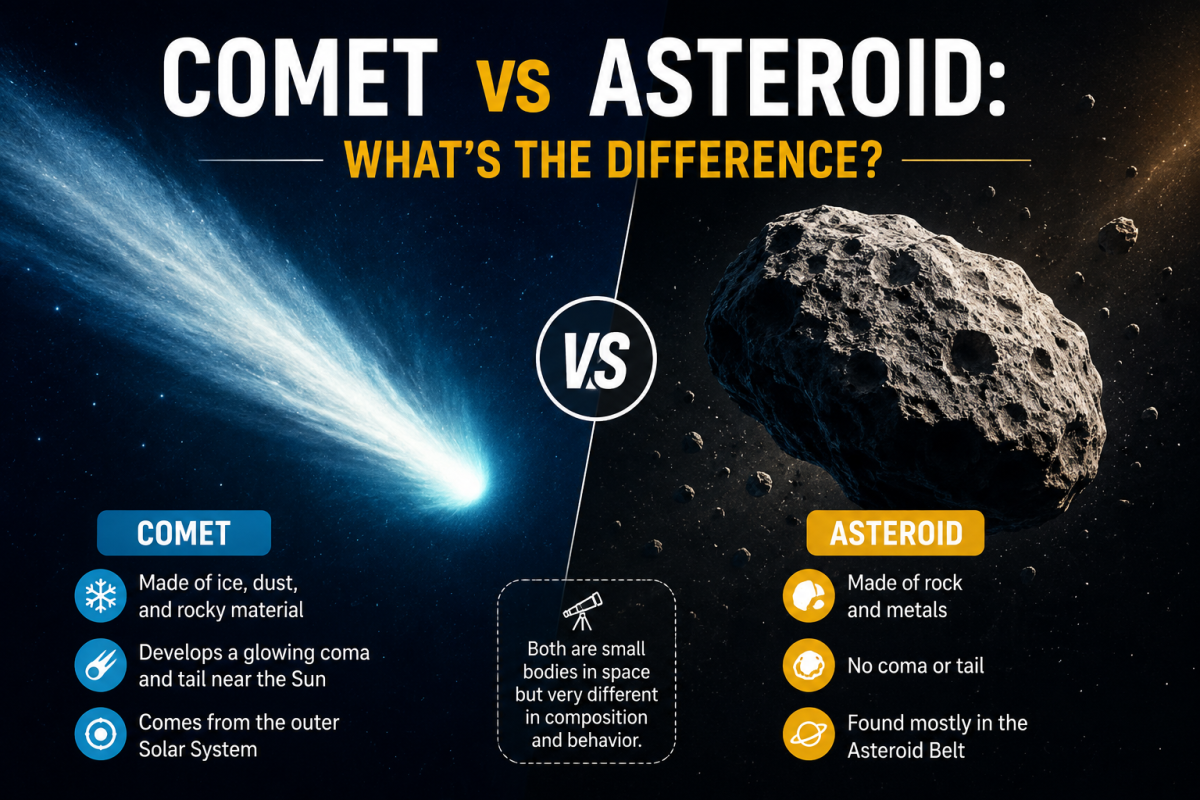
Both comets and asteroids are small bodies left over from the formation of the Solar System, but they differ mainly in composition and behavior.
A comet contains substantial ice and volatile material mixed with dust and rocky material. When a comet approaches the Sun, solar heating can cause some of its volatile material to escape, producing a coma and, when conditions are right, a visible tail.
An asteroid is generally a rocky or metallic body that does not normally develop a coma or tail. Most asteroids are found in the main asteroid belt between Mars and Jupiter, although many also occupy other orbits.
The simplest comparison is:
Comet → ice + dust + rock → can become active near the Sun
Asteroid → mainly rock and/or metal → usually remains inactive
But that is only the starting point. Some asteroids can show comet-like activity, and some cometary bodies can become difficult to distinguish from asteroids.
Comet vs Asteroid at a Glance
Feature Comet Asteroid
Main composition Ice, dust, rock, volatile materials Mostly rock and/or metal
Formation environment Predominantly colder regions of the early Solar System Predominantly warmer rocky regions
Typical locations Kuiper Belt, Oort Cloud, and related comet reservoirs Mainly the asteroid belt, plus near-Earth and other populations
Activity near the Sun Can release gas and dust Usually little or no visible activity
Coma Can develop one Normally absent
Tail Can develop one or more tails Usually absent
Appearance in a telescope Can become fuzzy when active Often appears as a point of light
Orbit Can be highly elongated Can have many different orbital shapes
Important exceptions Dormant or depleted comets Active asteroids
The important word in this table is usually. Neither category follows a single rule in every case.
What Is a Comet?
A comet is a small Solar System body that contains ice, dust, rock, and volatile compounds.
Its solid center is called the nucleus. When a comet remains far from the Sun, much of its volatile material stays frozen and the object can appear relatively inactive.
As it moves into the inner Solar System, increasing sunlight heats its surface. Volatile material can then sublimate, changing directly from solid to gas.
The escaping material forms a cloud around the nucleus called the coma. Dust and electrically charged gas can then be shaped by sunlight and the solar wind to create comet tails.
For a more detailed explanation of this process, see Why Do Comets Have Tails?.
What Are Comets Made Of?
Comet nuclei contain mixtures of:
water ice and other frozen volatiles
dust
rocky material
organic compounds
gases such as carbon monoxide and carbon dioxide
The exact composition varies between comets.
This mixture is important because it explains why comets can become active when they approach the Sun.
What Is an Asteroid?
An asteroid is a relatively small natural body that orbits the Sun and is generally dominated by rocky or metallic material.
Asteroids come in many shapes and sizes. Some are irregular, some are relatively rounded, and some have moons of their own. NASA notes that most asteroids are located in the asteroid belt between Mars and Jupiter, but asteroids also exist in near-Earth and other populations.
Unlike an active comet, an ordinary asteroid does not usually develop a large coma and tail when it approaches the Sun.
That does not mean asteroids are always completely inactive. Some can eject particles, develop dust, or otherwise show unusual activity.
Why Are Comets Icy but Asteroids Usually Rocky?
The difference starts with where these bodies formed.
The early Solar System contained a disk of gas and dust around the young Sun. Temperatures were much higher close to the Sun and much colder farther away.
Farther from the Sun, water and other volatile compounds could remain frozen. Those colder regions provided an environment where icy bodies could form and survive.
Closer to the Sun, temperatures made it much harder for volatile ices to remain stable at the surface.
That is why many comets are associated with colder outer regions, while the main asteroid belt contains mostly rocky bodies. NASA identifies the Kuiper Belt beyond Neptune and the distant Oort Cloud as major comet reservoirs, while the asteroid belt occupies the region between Mars and Jupiter.
So rather than memorizing “comets are ice and asteroids are rock,” it is more useful to remember:
Formation environment → temperature → materials that could remain stable → composition
Where Are Comets and Asteroids Found?
Where Are Comets Found?
Many comets originate in the colder outer Solar System.
Short-period comets are commonly associated with the Kuiper Belt, beyond Neptune. Many take less than about 200 years to orbit the Sun.
Long-period comets are associated with the much more distant Oort Cloud, a huge reservoir surrounding the Solar System.
Gravitational interactions can change a comet’s orbit and send it toward the inner Solar System.
Where Are Asteroids Found?
The largest concentration of known asteroids lies in the main asteroid belt between Mars and Jupiter. However, asteroids also occupy near-Earth orbits, Trojan populations, and other regions of the Solar System.
So location provides a useful clue, but it does not define every object.
How Are Comet and Asteroid Orbits Different?
People often say that comets have highly elliptical orbits while asteroids have more circular orbits.
That is a useful generalization, but it is not a strict rule.
Many comets do travel on highly elongated orbits that carry them far from the Sun before bringing them back through the inner Solar System.
Asteroids have a much wider range of orbital shapes. Many main-belt asteroids have relatively modest eccentricities, but near-Earth asteroids and other populations can have substantially different orbits.
For this reason, orbit alone cannot always tell you whether an object is a comet or an asteroid.
The object’s composition and physical activity also matter.
Why Do Comets Develop Tails?
This is one of the clearest visible differences between an active comet and a typical asteroid.
When a comet approaches the Sun, heat can cause volatile material to sublimate from its nucleus. Escaping gas can carry dust away from the surface and create the coma.
Solar radiation and the solar wind then interact with that material.
A comet can develop a dust tail and an ion tail, which usually extend generally away from the Sun.
That is why a comet can suddenly become much brighter and more visually impressive as it approaches the Sun.
A typical asteroid does not have the same inventory of readily accessible volatile material, so it normally does not produce a classic cometary coma and tail.
Do Asteroids Ever Have Tails?
Yes.
This is an important exception because it shows that the comet-versus-asteroid boundary is not perfectly rigid.
NASA’s observations of 3200 Phaethon are a good example. Phaethon is classified as an asteroid and is associated with the Geminid meteor shower, but observations have found comet-like behavior, including a faint tail. NASA research suggests that sodium vapor released from the intensely heated asteroid may help explain this activity.
Scientists often use the term active asteroid for asteroid-like objects that display activity.
Phaethon is therefore especially useful because it demonstrates that:
A tail does not automatically mean that an object is a traditional comet.
The physical mechanism behind the activity matters.
Can a Comet Become Asteroid-Like?
Yes.
A comet repeatedly passing close to the Sun can gradually lose volatile material from its surface.
As the accessible volatile material becomes depleted, the comet may become much less active. Its coma and tail can weaken or disappear, making the object look more like an asteroid.
Astronomers use terms such as dormant comet or extinct comet for different stages or interpretations of this kind of evolution.
This creates an important connection between the two categories:
Active comet → repeated solar heating → volatile loss → reduced activity → asteroid-like appearance
That is one reason scientists sometimes cannot determine an object’s history from its appearance alone.
Comet vs Asteroid: Which Is Bigger?
There is no simple size rule.
Both comets and asteroids exist across a broad range of sizes, and their populations overlap.
For example, NASA has observed relatively small comet nuclei and enormous asteroids such as Ceres.
So statements like “asteroids are bigger than comets” or “comets are smaller than asteroids” are misleading.
Size can help describe an individual object, but it does not provide a reliable definition of the category.
What Do Comets and Asteroids Have in Common?
Despite their differences, comets and asteroids share a great deal.
Both:
orbit the Sun,
are small compared with planets,
formed from material associated with the early Solar System,
preserve information about planetary formation,
can interact gravitationally with planets,
can enter near-Earth orbits,
and can produce smaller fragments.
NASA describes both asteroids and comets as leftovers from the formation of the Solar System about 4.6 billion years ago.
They are therefore not completely separate kinds of worlds. They are part of a broader population of small Solar System bodies.
Comet vs Asteroid vs Meteoroid vs Meteor vs Meteorite
These terms are often confused.
A meteoroid is a small piece of rock or metal traveling through space. It can originate from an asteroid, a comet, or another body.
When a meteoroid enters Earth’s atmosphere and produces the bright streak commonly called a shooting star, we call the phenomenon a meteor.
If some of the material survives atmospheric entry and reaches the ground, it becomes a meteorite.
The sequence is:
Asteroid or comet → fragment → meteoroid → atmosphere → meteor → surviving material → meteorite
Comets can also leave debris streams that produce meteor showers when Earth crosses them.
Are Comets or Asteroids More Dangerous to Earth?
Neither is automatically more dangerous.
Potential impact risk depends on an object’s:
size,
orbit,
speed,
composition,
and probability of encountering Earth.
Both asteroids and comets can enter near-Earth space.
NASA and JPL track near-Earth objects and calculate their orbits to evaluate possible close approaches and impact risks.
The important point is that classification alone does not determine danger.
Why the Comet-Asteroid Boundary Is Not Always Clear
Modern observations have made the old textbook distinction less absolute.
A typical comet is icy and can become active near the Sun.
A typical asteroid is rocky and generally remains inactive.
But nature produces exceptions.
Some asteroids show tails or eject dust. Some cometary bodies lose much of their volatile material and become asteroid-like. Other unusual objects can share physical characteristics of both groups.
That is why modern astronomy increasingly looks at an object’s composition, activity, orbit, and evolution together, rather than relying on one simple visual label.
A Broader Look at Comet Research
JMCCanneyScience contains a large body of research focused on comets, the Solar System, and space science.
Readers who want to explore the site’s wider material can visit Research Topics, which includes topics such as the Plasma Discharge Comet Model and other Solar System research.
For McCanney’s broader comet-related work, Planet X, Comets and Earth Changes provides another relevant starting point.
The site’s Comets material provides a more direct route for readers interested specifically in comet research.
These pages represent McCanney’s own research and proposed interpretations. They should be distinguished from the mainstream astronomical explanations used in the comparison above.
Frequently Asked Questions
What is the main difference between a comet and an asteroid?
Comets contain substantial volatile and icy material and can become active near the Sun, while asteroids are generally rocky or metallic and usually remain inactive.
Are comets made of ice?
Yes. Comets contain ice and other volatile materials mixed with dust and rocky material.
Are asteroids made of metal?
Some asteroids contain substantial metal, while others are dominated by rock or carbon-rich material. Asteroids are not all made from the same composition.
Why do comets have tails?
Solar heating causes volatile material to escape from a comet. The released gas and dust can then be shaped by sunlight and the solar wind into tails.
Can an asteroid have a tail?
Yes. Some active asteroids, including Phaethon, can produce comet-like activity.
Where do most asteroids come from?
Most known asteroids are concentrated in the main asteroid belt between Mars and Jupiter, although many occupy other orbits.
Where do comets come from?
Many short-period comets are associated with the Kuiper Belt, while many long-period comets are associated with the Oort Cloud.
Are asteroids and comets the same thing?
No, but they share a common history as remnants of Solar System formation, and some objects blur the traditional distinction.
What is the difference between a meteoroid, meteor, and meteorite?
A meteoroid is the object in space. A meteor is the visible event when it enters an atmosphere. A meteorite is material that survives and reaches the ground.
The Bottom Line
The difference between a comet and an asteroid comes down primarily to composition, formation environment, and how each object behaves when exposed to the Sun.
Comets contain significant ice and volatile material. When they approach the Sun, that material can escape and create a coma and tail.
Asteroids are generally rocky or metallic and usually remain relatively inactive.
But the distinction is not absolute.
Active asteroids can produce comet-like activity, while dormant or depleted comets can become difficult to distinguish from asteroids.
So the best way to understand the difference is not simply:
Comets = ice. Asteroids = rock.
A better explanation is:
Comets and asteroids are both ancient small bodies from the early Solar System, but differences in composition and formation environment give them different behavior—while some unusual objects show that the boundary between the two is not always sharp.
Interested in Learning More About This Research?
If you would like to explore more about comets, Solar System research, McCanney’s publications, or available consulting services, contact us to discuss your questions.
Call Now: 612-232-6651