
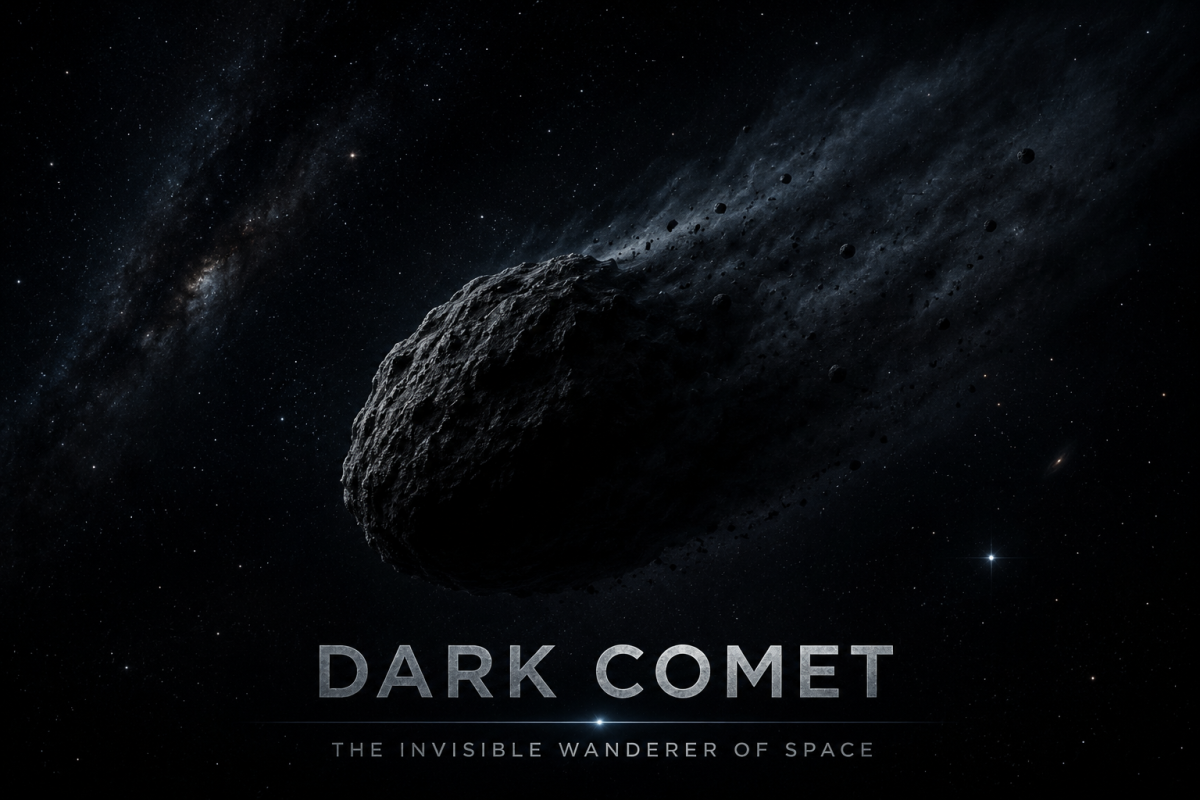
What Is a Dark Comet?
A dark comet is a small Solar System object that looks like an asteroid but shows comet-like behavior in its motion, even though it may not display the obvious coma or tail normally associated with an active comet. NASA describes dark comets as objects that look like asteroids but act like comets.
The key clue is an unusual change in the object’s motion called nongravitational acceleration. In simple terms, astronomers find that the object is not following the path they would expect from gravity alone.
One possible explanation is weak outgassing: volatile material may escape from the surface and produce a tiny recoil force.
So the simplest definition is:
A dark comet looks like an asteroid, but its motion can reveal hidden comet-like activity.
Why Are Dark Comets Called “Dark”?
“Dark” does not necessarily mean that a dark comet is literally black.
The name mainly refers to its lack of obvious visible cometary activity. A normal active comet can develop a bright coma and tail when material escapes from its nucleus. A dark comet may remain a point of light in telescope images even while its orbit shows an unusual acceleration.
This makes dark comets difficult to identify using appearance alone.
Dark Comet vs. Asteroid vs. Normal Comet
Feature Asteroid Active Comet Dark Comet
Appearance Usually asteroid-like Can develop a coma and tail Usually asteroid-like
Visible activity Usually absent Often visible when active Weak or not obvious
Motion Primarily modeled through gravity and known forces Can change because of outgassing Shows measurable nongravitational acceleration
Main mystery — Visible comet activity Comet-like motion without obvious activity
The important distinction is that a dark comet is not simply a very dark asteroid. Its unusual orbital behavior is what makes it scientifically interesting.
What Is Nongravitational Acceleration?
The term sounds complicated, but the idea is simple.
Astronomers use observations to calculate an object’s orbit. They then compare the predicted position with where the object actually appears.
If repeated measurements show that the object is slightly deviating from its expected gravitational path, researchers look for another force.
That additional change in motion is called nongravitational acceleration.
For dark comets, this is one of the most important clues because it suggests that something besides ordinary gravity is affecting the object.
What Could Cause the Acceleration?
One leading explanation is outgassing.
Some comets contain volatile material that can turn into gas when heated by the Sun. When gas escapes from a small body, it carries momentum with it. The escaping material can therefore produce a small recoil force.
Think of it as a very weak natural rocket:
volatile material → gas escapes → recoil force → small change in motion
For an ordinary comet, this process can produce an obvious coma or tail.
For a dark comet, the activity may be weak enough that astronomers can measure its effect on the orbit without immediately seeing the material escaping.
That explanation is still being investigated for individual objects; scientists do not assume that every dark comet has exactly the same mechanism.
Why Don’t Dark Comets Have Obvious Tails?
That is one of the main questions behind dark-comet research.
A dark comet could potentially release such a small amount of material that the resulting coma or tail remains below the detection limit of earlier observations. Activity could also be localized or contain little visible dust.
Recent observations are making this question especially interesting.
In July 2026, Nature Astronomy reported the detection of a cometary tail on a near-Earth object whose comet-like nongravitational acceleration had already suggested hidden activity.
NASA also reported in July 2026 that 1998 SH2, previously treated as an asteroid, was shown to be a comet after observations detected weak cometary activity.
These discoveries show why orbital measurements can be important even when a cometary tail is not immediately visible.
How Are Dark Comets Detected?
Scientists can identify potential dark comets through precise position measurements and orbital calculations.
The process is straightforward:
A telescope detects a small object.
Astronomers measure its position over time.
Researchers calculate its orbit.
New observations test whether the object follows the predicted path.
Any persistent unexplained acceleration is investigated.
Astronomers search for faint coma, dust, or tail activity.
This means a dark comet can be recognized through how it moves, not just through what it looks like.
The 2026 work on 1998 SH2 is a good example of how improved tracking and more sensitive observations can change our understanding of an object.
Are There Different Types of Dark Comets?
Yes. NASA’s 2024 research identified two broad populations of dark comets.
Inner Dark Comets
Inner dark comets are smaller objects found in the inner Solar System. NASA describes them as generally tens of meters or less in size and moving in nearly circular orbits.
Outer Dark Comets
Outer dark comets are larger and follow more eccentric or elongated orbits. NASA describes them as hundreds of meters or more across, with orbital characteristics resembling Jupiter-family comets.
The two populations suggest that dark comets may not all share the same history.
Where Do Dark Comets Come From?
Scientists do not yet have one confirmed answer.
Researchers are examining several possibilities, including connections with the main asteroid belt, comet-like populations, and evolutionary processes that can change small bodies over time.
A 2024 Icarus study explored possible evolutionary pathways involving rotational fragmentation and the ν6 resonance. These are useful research concepts, but they should be treated as hypotheses under investigation rather than as a final explanation for every dark comet.
For readers who want to explore broader comet questions and McCanney’s work, visit the Comets section of JMCCanneyScience.
Is ʻOumuamua a Dark Comet?
No.
ʻOumuamua was the first confirmed interstellar object observed passing through our Solar System. It is not classified as a confirmed dark comet.
However, its unusual motion and lack of obvious cometary activity helped researchers think more deeply about objects that can show unexplained nongravitational behavior. NASA specifically describes ʻOumuamua as an important object for understanding the dark-comet phenomenon, rather than as a dark comet itself.
What Do We Know About Dark Comets?
The strongest evidence is observational.
Scientists have identified small bodies that:
look like asteroids,
show unusual nongravitational motion,
often lack an obvious coma or tail,
and may represent weakly active or otherwise unusual cometary bodies.
NASA’s 2024 study reported 14 known dark comets at that time and identified two broad populations. By 2026, NASA described the known population more generally as about a dozen while highlighting new work on objects such as 1998 SH2.
This difference in wording reflects an evolving research field, so it is better to use “14 identified in the 2024 study” than to present 14 as a permanent current total.
What Scientists Still Don’t Know
Dark-comet research is still developing.
Scientists are continuing to investigate:
exactly what causes the acceleration,
how much volatile material these objects contain,
why some show no obvious activity,
where the different populations originated,
and how many apparently inactive near-Earth objects may actually have weak cometary activity.
NASA has also raised the possibility that dark comets could have contributed materials relevant to the development of life on Earth. That remains a research question, not an established history of delivery.
Dark Comets and JMCCanneyScience Research
JMCCanneyScience has a substantial body of work focused on comets and the electrical nature of the Solar System.
Readers interested in the site’s broader research can explore Comet Research and Research Topics, including the site’s Plasma Discharge Comet Model.
For McCanney’s broader comet-related publications, see Planet X, Comets and Earth Changes.
These pages present McCanney’s research and proposed interpretations. They should be distinguished from the mainstream scientific research summarized in the sections above.
The Bottom Line
A dark comet is an unusual small Solar System object that looks like an asteroid but shows comet-like behavior through its motion.
The most important clue is nongravitational acceleration.
One leading explanation is weak outgassing, where volatile material escapes from the surface and produces a small recoil force. But researchers are still studying the exact causes, origins, and physical properties of these objects.
Recent 2026 observations show why the subject matters: an object can appear inactive at first and later reveal weak cometary activity when astronomers combine precise orbital tracking with more powerful observations.
Dark comets therefore challenge a simple classification:
Some objects look like asteroids but may hide cometary behavior that only their motion reveals.
Frequently Asked Questions
What is a dark comet?
A dark comet is an asteroid-like object that shows measurable comet-like nongravitational motion without an obvious coma or tail.
Is a dark comet black?
Not necessarily. “Dark” mainly refers to the lack of obvious visible cometary activity.
What is the difference between a dark comet and an asteroid?
A dark comet can look like an asteroid but show an unexplained change in its motion that may be associated with comet-like activity.
What causes dark-comet acceleration?
Weak outgassing is one leading explanation, although researchers are still investigating the cause for individual objects.
How are dark comets detected?
Astronomers combine precise position measurements, orbital calculations, long-term tracking, and searches for faint cometary activity.
How many dark comets are known?
NASA reported 14 identified dark comets in its December 2024 study. The number and classification of known objects can change as researchers make new observations.
Are inner and outer dark comets different?
Yes. NASA’s 2024 research identified smaller inner objects with nearly circular orbits and larger outer objects with more eccentric orbits.
Is ʻOumuamua a dark comet?
No. It is an interstellar object that helped researchers understand the phenomenon but is not classified as a confirmed dark comet.
Interested in Learning More About This Research?
If you would like to learn more about McCanney’s research, comet-related research, publications, or available consulting services, contact us to discuss your questions.
Call Now: 612-232-6651
JMCCanneyScience also lists Consulting in its main Space Program navigation for readers interested in discussing research and technical subjects.