
Why Do Comets Have Tails?
Comets are among the most recognizable objects in the Solar System because of their bright, extended tails. But a comet does not carry a permanent tail through space. Its tail develops when the comet approaches the Sun and its frozen, volatile material begins responding to solar energy.
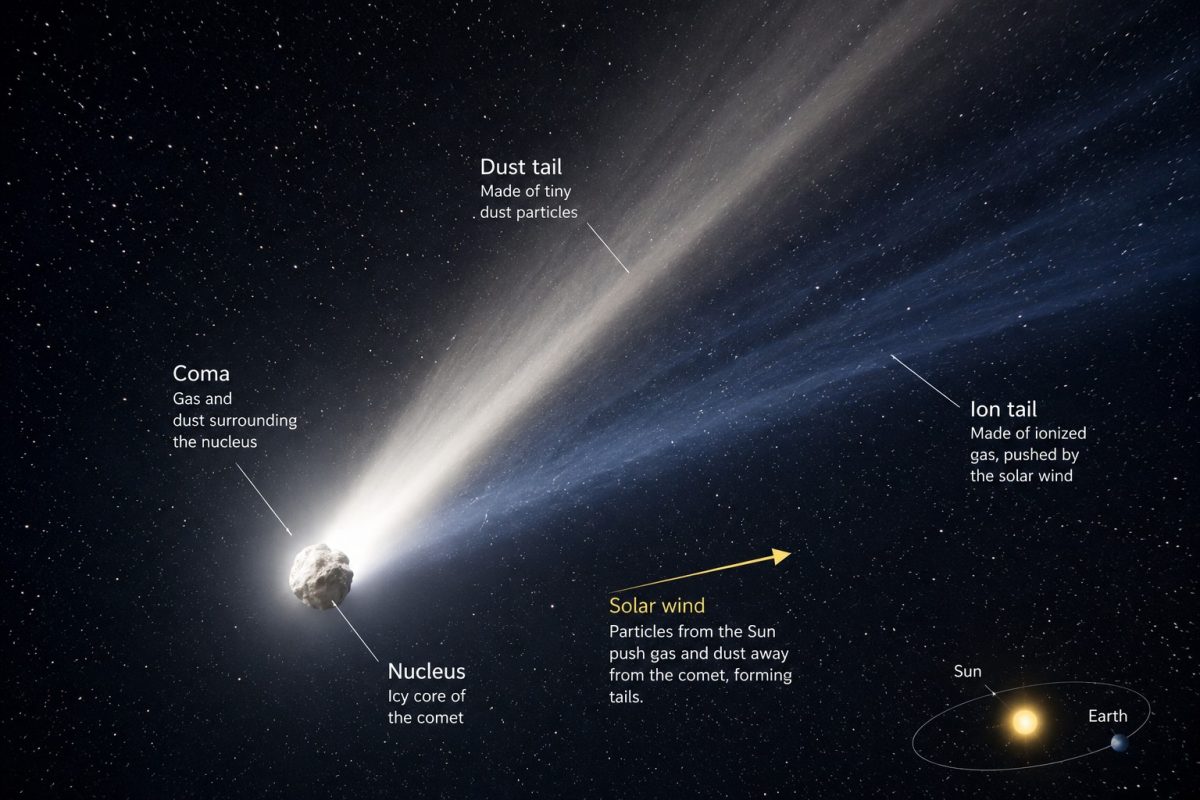
As a comet moves into the warmer regions of the inner Solar System, sunlight heats its nucleus. Ice and other volatile substances escape from the surface as gas, carrying dust with them. This creates a surrounding cloud called the coma. Solar radiation pressure and the solar wind then act on the material released from the comet, producing the structures we see as comet tails.
Most visible comets show two major tails:
a dust tail, made primarily of solid dust particles
an ion tail, also called a plasma tail, made of electrically charged gas
These tails form through different physical processes, which is why they can have different colors, shapes, and directions.
The most important point is this:
A comet’s tail does not simply trail behind the comet because it is moving through space. The Sun actively shapes the material around the comet.
That distinction explains why a comet can sometimes have a tail that points in a direction that looks completely wrong relative to its motion.
What Is a Comet Made Of?
Before understanding a comet’s tail, it helps to understand the comet itself.
A comet has a solid central body called the nucleus. NASA describes comet nuclei as containing ice, frozen gases, and embedded dust. Those materials stay relatively inactive when the comet remains far from the Sun.
Comet material can include:
water ice
frozen gases and other volatile compounds
dust
rocky material
organic compounds
small solid particles
The word volatile refers to substances that can change readily from a solid or liquid state into gas under relatively low temperatures.
A comet therefore behaves differently from an asteroid. An asteroid is generally dominated by rock or metal, while a comet contains a significant inventory of volatile material that can become active when solar heating increases.
You may also encounter the classic phrase “dirty snowball,” a description associated with the traditional model of a comet nucleus. The expression is useful as a simple analogy, but an actual comet is more complicated than an ordinary snowball made from clean water ice. Space missions have shown that comet nuclei have complex, dark, dusty and chemically varied surfaces.
For a deeper look at comet structure, see Geology of Comets.
What Happens When a Comet Approaches the Sun?
The Sun is the key to understanding comet activity.
A comet that spends most of its orbit in the cold outer Solar System may show little or no obvious tail. As it travels toward the inner Solar System, increasing sunlight warms its surface.
The change is especially important near perihelion, the point in a comet’s orbit where it passes closest to the Sun.
As solar energy reaches the nucleus, volatile material can sublimate. Sublimation occurs when a substance changes directly from a solid into gas without first becoming a liquid.
In a comet, this process releases gas from the surface and subsurface regions. Escaping gas can drag dust particles outward with it, creating an expanding cloud around the nucleus. That cloud is the coma.
So the sequence is:
Sunlight → heating → sublimation → escaping gas and dust → coma → tails
The closer and more active the comet becomes, the more dramatic this process can appear.
What Is a Comet’s Coma?
The coma is the large envelope of gas and dust surrounding the comet’s nucleus.
It forms when material escaping from the nucleus expands into space. The coma can become vastly larger than the solid nucleus itself, and it is often the first major sign that a previously faint comet has become active.
The coma is important because the tail does not appear from nowhere. The comet first releases material into its surrounding environment. Solar radiation and the solar wind then interact with that material and organize some of it into extended tails.
In other words, the coma is the source region from which the visible tail develops.
How Does a Comet Tail Form?
A comet tail forms when material released from the nucleus is acted upon by the Sun.
Two major solar effects are especially important:
Solar radiation pressure acts on dust.
The solar wind interacts strongly with charged particles and helps shape the ion tail.
Solar ultraviolet radiation also contributes to the ionization of gas molecules around an active comet. Once gas becomes electrically charged, it behaves as plasma and interacts with the electromagnetic environment around the Sun.
This produces two distinct tail structures.
What Are the Two Types of Comet Tails?
1. The Dust Tail
The dust tail contains small solid particles released from the comet.
Sunlight exerts a tiny but real pressure on those particles. This is called radiation pressure. Each photon of light carries momentum, and when sunlight interacts with matter, it can transfer some of that momentum to the material.
For a microscopic dust particle, the effect is small. But enormous numbers of particles are involved, and the particles remain exposed to sunlight as the comet travels around the Sun.
The result is a broad, diffuse tail that often appears white or yellowish because the dust reflects sunlight.
2. The Ion Tail
The ion tail, also called the plasma tail, consists of electrically charged particles.
Solar ultraviolet radiation can ionize gas released by the comet. The resulting ions interact strongly with the solar wind and the magnetic field carried by that wind.
The ion tail is typically narrower and more sharply directed than the dust tail. It often appears blue because some of the ionized molecules emit light through fluorescence.
Dust Tail vs. Ion Tail
Feature Dust Tail Ion Tail
Main material Dust particles Ionized gas
Major solar influence Radiation pressure Solar wind and electromagnetic effects
Typical appearance Broad and curved Narrow and straighter
Typical color White or yellowish Often blue
Relationship to comet orbit More strongly shaped by orbital motion More directly aligned away from the Sun
These are not two versions of the same tail. They are two different populations of material responding differently to the solar environment.
Why Does a Comet’s Tail Point Away From the Sun?
This is one of the most important questions in comet science.
Many people naturally assume that a comet’s tail should point behind it, like the wake behind a boat. But space does not work that way.
There is essentially no atmosphere producing ordinary air resistance around a comet. Instead, the tail forms because solar forces act on material around the comet.
The ion tail points away from the Sun because the solar wind carries charged particles and magnetic fields outward from the Sun. The charged gas released by the comet becomes part of this interaction and forms a tail that generally points in the anti-solar direction.
The dust tail is also pushed generally away from the Sun by radiation pressure, but dust particles are heavier and remain strongly influenced by gravity and their orbital motion. That is why the dust tail usually appears curved rather than perfectly straight.
Does a Comet’s Tail Always Trail Behind It?
No.
A comet’s tail does not necessarily point opposite the direction in which the comet is traveling.
Its direction is governed primarily by its relationship with the Sun and by the forces acting on the released material.
This means a comet traveling away from the Sun can have its tail extending in front of it rather than behind it. ESA specifically notes that this can happen because the tail points away from the Sun rather than simply opposite the comet’s direction of travel.
That single fact resolves one of the most common misconceptions about comet tails.
Why Is the Dust Tail Curved?
The dust tail is curved because dust particles do not respond to solar radiation in exactly the same way as the much lighter ions in the ion tail.
Each dust particle remains under the influence of the Sun’s gravity while radiation pressure pushes it outward. At the same time, the particle retains orbital motion inherited from the comet.
Different dust particles can also have different sizes and therefore respond differently to radiation pressure.
The result is a broad, curved structure rather than a narrow straight line. NASA explains that relatively massive dust particles accelerate more slowly and remain more strongly influenced by orbital motion, producing a curved dust tail.
This is why photographs of bright comets often show the dust tail bending gently away from the comet’s path.
For more on Comet Orbital Dynamics, see Comet Orbital Dynamics.
Why Is the Ion Tail Straighter?
The ion tail consists of particles that are far lighter and electrically charged.
Once the gas becomes ionized, the solar wind and the electromagnetic environment surrounding the Sun can strongly influence its motion. As a result, the ion tail tends to form a narrow structure pointing away from the Sun.
The two tails can therefore separate visibly:
Dust: broad, curved, reflective
Ions: narrow, straighter, often bluish
This difference provides a striking demonstration of how different physical forces act on different forms of matter in space.
What Is Solar Wind?
The solar wind is a continuous flow of charged particles from the Sun.
It includes particles such as protons and electrons and carries magnetic fields outward through the Solar System.
When an active comet enters this environment, the solar wind interacts with the ionized material surrounding the comet. That interaction helps create and shape the ion tail.
The solar wind is therefore an essential part of comet-tail physics.
It also explains why the comet’s environment cannot be understood by thinking only about sunlight and heat. A comet is moving through a dynamic electromagnetic environment created by the Sun.
For related material on the relationship between the Sun and the surrounding Solar System, see the Sun-Earth Connection.
How Does Sunlight Push Dust in Space?
It may seem strange that light can push something, but photons carry momentum.
When sunlight strikes a dust particle, the interaction can transfer momentum to that particle. This creates a small force known as radiation pressure.
For a large object, the effect is usually tiny. But comet tails contain enormous numbers of very small particles, making the cumulative effect visible on astronomical scales.
Radiation pressure does not make the dust instantly shoot away in a perfectly straight line. Solar gravity and the dust particle’s orbital motion remain important. The combined effects produce the characteristic broad and curved dust tail.
Why Do Comets Have Tails Only Near the Sun?
A comet can travel for long periods through the colder outer Solar System without developing the spectacular tail seen in famous comet photographs.
The reason is simple: comet activity depends strongly on solar heating.
As a comet moves farther from the Sun, the available solar energy decreases. When the comet approaches the inner Solar System, heating becomes stronger and volatile materials become increasingly active.
That is why a comet can transform from a comparatively inactive nucleus into an object surrounded by a large coma and extended tails during part of its orbit.
The tail is therefore not a permanent feature attached to the comet.
It is a temporary structure created by the comet’s interaction with its solar environment.
Why Are Some Comet Tails Blue and Others White?
The different colors generally come from the different materials and physical processes involved.
The dust tail primarily reflects sunlight, so it commonly appears white, yellowish, or slightly reddish depending on the viewing conditions and the properties of the dust.
The ion tail can appear blue because ionized molecules can fluoresce after interacting with sunlight. ESA notes that carbon monoxide ions can contribute to the characteristic blue appearance of plasma tails.
So the color difference is not just a photographic effect. It reflects different kinds of material around the comet.
How Long Can a Comet Tail Become?
Some comet tails can stretch for millions of kilometres.
The scale can become enormous because the material released from the comet continues spreading through space while solar forces act on it. NASA has documented comet tails and related structures extending extraordinary distances, including Comet McNaught’s dust tail, which stretched over 100 million miles in observations made by the STEREO mission.
The impressive length does not mean the comet itself is enormous.
The nucleus may be only a few kilometres across while the surrounding coma and tail extend vastly farther.
That enormous difference in scale is one of the most remarkable features of comet physics.
Do Comets Always Have Tails?
No.
A comet can be active without producing a prominent tail visible from Earth.
Tail development depends on the comet’s distance from the Sun, the amount and type of material it releases, the activity of its nucleus, the properties of the surrounding solar wind, the viewing geometry, and the sensitivity of the observing instrument.
A comet may also have weak structures that are difficult to see even when material is escaping from the nucleus.
So “comet” does not mean “object that always has a giant visible tail.”
Can a Comet Have More Than Two Tails?
The two main categories are the dust tail and ion tail, but comet images can sometimes show additional structures.
One example is an anti-tail.
An anti-tail is an apparent tail-like feature that seems to point toward the Sun. It can result from viewing geometry and the way larger dust particles remain distributed near the comet’s orbital plane. ESA explains that an apparent third tail can arise because of the relative positions of the Earth, Sun, and comet.
This does not mean the Sun has suddenly reversed the direction of the comet’s main tail.
It is a reminder that what we see from Earth is a three-dimensional structure projected onto a two-dimensional sky.
What Is a Comet Dust Trail?
Not all dust released from a comet becomes part of the spectacular visible tail.
Some particles remain distributed along or near the comet’s orbit, creating a dust trail.
These persistent streams of debris are especially important because Earth can pass through them. When tiny particles from a cometary dust stream enter Earth’s atmosphere, they produce meteor showers.
The Perseids and Leonids are familiar examples of meteor showers associated with debris left along cometary orbits.
In this sense, a comet can leave a long-lasting legacy even after its bright tail has disappeared.
Where Do Comets Come From?
Comets occupy different regions of the Solar System.
Many short-period comets are associated with the outer Solar System and take less than about 200 years to complete an orbit around the Sun. Long-period comets can have vastly longer orbital periods, and many are associated with the distant Oort Cloud.
Another important reservoir is the Kuiper Belt, a region beyond Neptune containing many icy bodies.
Gravitational interactions can alter the paths of these objects and send some of them toward the inner Solar System. Once a comet approaches the Sun closely enough, solar heating can activate its nucleus and produce the coma and tails that make it visible.
Why Comet Tails Matter to Astronomy
A comet tail is more than a beautiful feature in the night sky.
Its structure provides information about the material leaving the nucleus and about the environment around the Sun.
Astronomers can study:
the composition of cometary gas and dust
how material escapes from a nucleus
solar radiation pressure
the solar wind
plasma behavior
magnetic-field interactions
the relationship between comet dust and meteor streams
changes in comet activity as the object moves around the Sun
The tail can therefore act as a natural laboratory for studying both the comet and the solar environment.
The Bigger Picture: Comets and the Sun
The most useful way to think about a comet tail is not as something permanently attached to a comet.
A comet is an object moving through the Solar System.
When it approaches the Sun, its environment changes dramatically. Solar energy activates volatile material in the nucleus, gas and dust escape into the surrounding space, a coma develops, and solar radiation and the solar wind begin shaping the released material.
The visible tail is the result of that interaction.
That is why the answer to “Why do comets have tails?” is not simply “because they melt.”
A more complete explanation is:
Comets develop tails when solar heating causes material to escape from their nuclei and the Sun’s radiation and solar wind act on that material, producing distinct dust and ion tails.
The dust tail reflects sunlight and is strongly shaped by radiation pressure, gravity, and orbital motion. The ion tail consists of charged gas and is strongly controlled by the solar wind and the electromagnetic environment around the Sun.
A Note on Different Comet Models
The explanation above describes the mainstream physical model used by NASA, ESA, and the broader astronomical community.
JMCCanneyScience also presents an alternative electrical interpretation of comet behavior, including the idea that comet activity is tied more fundamentally to electrical and plasma processes in the Solar System. The site has dedicated material on a Plasma Discharge Comet Model and a broader body of work concerning the electrical nature of the Solar System.
Readers interested in that perspective can explore the related JMCCanneyScience research and educational material. It is useful to distinguish that interpretation from the mainstream explanation rather than presenting the two as though they represent the same scientific consensus.
Frequently Asked Questions About Comet Tails
Why do comets have tails?
Comets develop tails when solar heating causes gas and dust to escape from the nucleus. Solar radiation pressure and the solar wind then act on that material, forming dust and ion tails.
What causes a comet’s tail?
The immediate source is material released from the comet’s nucleus. Solar radiation pressure primarily affects dust, while the solar wind strongly influences ionized gas.
Why do comets have two tails?
The dust tail and ion tail consist of different materials and respond differently to solar forces. That produces two distinct structures.
Why does a comet’s tail point away from the Sun?
Solar radiation pushes dust outward, while the solar wind carries ionized particles away from the Sun. As a result, comet tails generally point in the anti-solar direction.
Does a comet’s tail always trail behind it?
No. The tail follows the solar environment rather than simply following the comet’s direction of travel. A comet moving away from the Sun can have its tail extending in front of it.
Is there air resistance in space?
Ordinary atmospheric air resistance does not create a comet tail. The major forces involved are solar radiation pressure, gravity, and the interaction between ionized comet material and the solar wind.
What is a comet made of?
A comet nucleus contains ice, frozen gases, dust, and other material. The exact composition varies from comet to comet.
Why is a comet’s dust tail curved?
Dust particles remain affected by solar gravity and orbital motion while radiation pressure pushes them outward. Different particle sizes respond differently, producing a broad curved structure.
Why is the ion tail usually straight?
The ion tail consists of charged particles that interact strongly with the solar wind and its magnetic field, producing a narrower structure that generally points away from the Sun.
Can a comet have a tail pointing toward the Sun?
An apparent anti-tail can sometimes seem to point sunward. This is generally a viewing-geometry effect involving the distribution of dust rather than a reversal of the comet’s main tail.
Can you see a comet tail with the naked eye?
Some bright comets produce tails large and bright enough to see without optical aid, although visibility depends on the comet, its brightness, its location in the sky, light pollution, and observing conditions.
Final Answer: Why Do Comets Have Tails?
Comets have tails because their material changes as they move closer to the Sun.
Solar heating causes volatile material to escape from the nucleus, creating the coma. Dust and gas released from that region then encounter sunlight, radiation pressure, solar wind, gravity, and magnetic fields.
That interaction creates the two familiar comet tails:
The dust tail is made primarily of solid particles pushed and shaped by sunlight, gravity, and orbital motion.
The ion tail is made of charged gas and is strongly controlled by the solar wind and the Sun’s electromagnetic environment.
Most importantly, the tail does not simply point behind the comet. It points predominantly away from the Sun, which is why a comet’s tail can sometimes appear to lead the comet along its path.
A comet’s tail is therefore one of the clearest visible demonstrations of the powerful interaction between a small Solar System body and its star.