a main-blog – Jmccanneyscience
Preloader Close

What Is Space Weather?

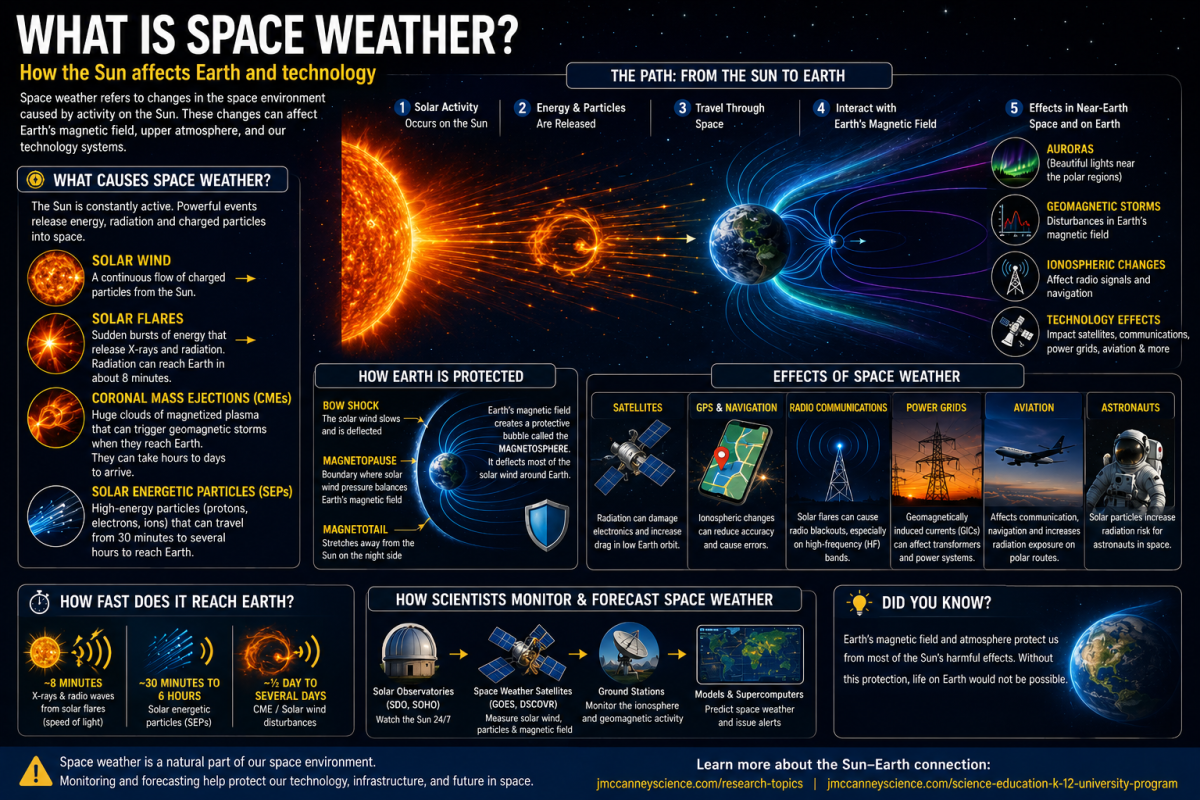
Space weather describes changing conditions in the space environment that are driven by activity from the Sun and can affect Earth, spacecraft, satellites, and modern technology.

The Sun does not remain completely quiet. It continuously releases the solar wind, and it can produce powerful events such as solar flares, coronal mass ejections (CMEs), and solar energetic particle events. When these disturbances interact with Earth’s magnetic field and upper atmosphere, they can produce auroras, geomagnetic storms, radio disruptions, satellite problems, navigation errors, and other effects.

The basic relationship is:

Sun → solar activity → solar wind / flares / CMEs → Earth’s space environment → space weather → effects on Earth and technology

So, unlike ordinary weather, space weather does not describe rain, wind, or temperature at Earth’s surface.

It describes conditions in space caused mainly by the changing activity of the Sun.

What Causes Space Weather?

Space weather begins with the Sun.

The Sun’s magnetic field is constantly changing, and those changes can release energy and particles into space.

The major drivers include:

Solar wind
Solar flares
Coronal mass ejections
Solar energetic particles
Changes in solar magnetic activity

NASA describes the solar wind, solar flares, CMEs, and solar particle events as important parts of the space-weather environment.

The Sun’s corona, its extremely hot outer atmosphere, is the source of the solar wind. Regions such as coronal holes can produce faster solar-wind streams.

What Is the Solar Wind?

The solar wind is a continuous stream of electrically charged particles flowing outward from the Sun.

It consists mainly of protons and electrons and carries the Sun’s magnetic field into interplanetary space. NASA describes it as a continuing outflow from the corona that extends throughout the Solar System.

The solar wind is not always the same.

Its speed, density, temperature, and magnetic-field conditions can change depending on where it comes from and how active the Sun is.

For a deeper explanation of the Sun-Earth interaction, read Solar Wind and Earth: How the Sun Affects Our Planet.

What Is a Solar Flare?

A solar flare is a sudden release of energy caused by changes in the Sun’s magnetic field.

Solar flares produce intense electromagnetic radiation, including X-rays and ultraviolet radiation.

Because electromagnetic radiation travels at the speed of light, its effects can reach Earth in about eight minutes when the flare is directed toward our planet.
Solar flares can disturb Earth’s ionosphere and interfere with some forms of radio communication.

A solar flare does not automatically produce a major geomagnetic storm. A CME may accompany a flare, but the two are different phenomena.

What Is a Coronal Mass Ejection?

A coronal mass ejection, or CME, is a large eruption of magnetized plasma from the Sun.

A CME can send enormous amounts of material and magnetic energy into space. When a CME reaches Earth, it can strongly interact with our magnetosphere and trigger a geomagnetic storm.

This distinction makes the space-weather chain easier to understand:

Solar flare → electromagnetic radiation

CME → large cloud of magnetized plasma

Solar wind → continuous flow of charged particles

They can occur together, but they are not interchangeable terms.

What Happens When Space Weather Reaches Earth?

Earth has a natural defense system against much of the Sun’s particle activity.

Our planet’s magnetic field creates the magnetosphere, a large magnetic region surrounding Earth.

When the solar wind reaches it, the magnetosphere is compressed on the Sun-facing side and stretched into a long magnetotail on the night side.

The magnetopause marks the outer boundary where the pressure of the solar wind interacts with Earth’s magnetic field.

The magnetosphere is not a solid wall. It is a dynamic system that changes as solar-wind conditions change. ESA’s 2026 SMILE mission is specifically designed to improve scientists’ understanding of how Earth’s magnetic shield responds to solar-wind streams and solar eruptions.

How Does Earth’s Magnetosphere Protect Us?

Most solar-wind particles are deflected around Earth rather than reaching the surface directly.

Earth also has an atmosphere that provides additional protection.

This combination matters because the solar wind is a continuous stream of charged particles. Without Earth’s magnetic field and atmosphere, the planet would interact with solar particles in a very different way. NASA describes the magnetosphere as an important protection against solar-wind effects and particle radiation.

But the magnetosphere does not simply block everything.

Some solar energy and charged particles can enter the near-Earth environment, especially during stronger disturbances.

What Is Magnetic Reconnection?

One of the key processes behind space weather is magnetic reconnection.

The solar wind carries the interplanetary magnetic field outward from the Sun. When this magnetic field interacts with Earth’s magnetic field under suitable conditions, magnetic reconnection can occur.

This process allows energy to move into the magnetosphere and can contribute to particle acceleration and geomagnetic activity.

In simple terms:

Solar wind + magnetic-field interaction → reconnection → energy transfer → magnetospheric disturbance

This process helps explain why a change in the solar wind can eventually produce effects near Earth.

How Does Space Weather Create Auroras?

Auroras are among the most visible effects of space weather.

When energetic charged particles enter Earth’s upper atmosphere near the polar regions, they collide with atmospheric gases.

These interactions transfer energy to atmospheric atoms and molecules. As that energy is released, the atmosphere produces the colored light we see as an aurora.

There are two main names:

Aurora borealis — Northern Lights

Aurora australis — Southern Lights

Oxygen and nitrogen contribute different colors depending on the altitude and energy involved.

So an aurora is not simply sunlight reflecting from the atmosphere.

It is a visible result of the interaction between:

solar particles + Earth’s magnetic field + upper-atmosphere gases

What Is a Geomagnetic Storm?

A geomagnetic storm is a significant disturbance in Earth’s magnetic environment caused by enhanced solar-wind conditions.

CMEs are an important source of major geomagnetic storms.

During a storm, Earth’s magnetosphere becomes highly disturbed. Auroras can become brighter and appear farther from the polar regions, while changes in the upper atmosphere and magnetic field can affect technological systems.

Geomagnetic storms can last for hours or, in stronger cases, continue for days.

How Does Space Weather Affect Satellites?

Satellites operate in an environment where space weather can matter significantly.

Strong solar activity can expose spacecraft to energetic particles, affect electronics, and increase the density of Earth’s upper atmosphere.

When the upper atmosphere expands, low-Earth-orbit satellites can experience greater atmospheric drag, changing their orbits.

Space weather can therefore affect:

satellite electronics
spacecraft communications
navigation systems
satellite operations
orbital predictions
spacecraft radiation exposure

NASA identifies satellite damage, communication problems, and navigation effects among the possible consequences of strong space-weather events. (science.nasa.gov)

Can Space Weather Affect GPS?

Yes.

Space weather can disturb the ionosphere, an electrically active part of Earth’s upper atmosphere.

GPS and other satellite-navigation systems rely on radio signals traveling through the space environment around Earth. Changes in the ionosphere can alter signal propagation and reduce positioning accuracy.

This makes space weather relevant to:

navigation
aviation
shipping
surveying
telecommunications
timing systems

The effect is not necessarily a complete loss of GPS. In many cases, the concern is reduced accuracy or reliability.

Can Space Weather Disrupt Radio Communications?

Yes.

Solar activity can disturb the ionosphere and change the way radio waves travel through it.

Solar flares can produce strong X-ray and ultraviolet radiation that affects the ionosphere rapidly, which can lead to radio blackouts, particularly at high frequencies used for some communications.

This is particularly important for aviation and other systems that rely on high-frequency radio.

It also explains why space-weather forecasts are not only useful to astronomers.

They can matter to people operating real-world communication systems.

Can Space Weather Affect Power Grids?

Yes.

Strong geomagnetic disturbances can cause changes in Earth’s magnetic field.

Those changing magnetic fields can induce electric currents in long conducting systems on the ground. These geomagnetically induced currents can affect power-grid equipment and other infrastructure.

The basic chain is:

Solar disturbance → geomagnetic activity → changing magnetic field → induced currents → infrastructure effects

This is one reason extreme space weather is considered an engineering and infrastructure concern.

Can Space Weather Affect Astronauts?

Yes.

People on Earth’s surface receive substantial protection from the atmosphere and magnetosphere.

Astronauts in space do not have the same level of natural protection.

Solar energetic particles (SEPs) can create significant radiation hazards during strong solar events. NASA identifies astronaut radiation exposure as one of the important reasons to monitor and forecast space weather.

This becomes especially important for future missions beyond low Earth orbit, where spacecraft spend more time outside Earth’s strongest magnetic protection.

How Fast Does Space Weather Reach Earth?

Different space-weather effects travel at different speeds.

Electromagnetic radiation

X-rays and other electromagnetic radiation from a solar flare travel at the speed of light and can reach Earth in about 8 minutes.

Solar energetic particles

Some energetic particles can arrive in tens of minutes to hours, depending on their energy and the path they take.

CME-related solar-wind disturbances

A CME can take many hours to several days to reach Earth depending on its speed and trajectory. This difference is important for forecasting because scientists can receive one type of warning before another effect arrives.

Does Space Weather Affect Earth’s Atmosphere?

Yes, particularly the ionosphere and thermosphere.

The ionosphere responds to changes in solar radiation and charged-particle activity. During strong space-weather events, the upper atmosphere can become heated and disturbed.

The thermosphere can also expand. That expansion increases atmospheric density at satellite altitudes and can increase drag on spacecraft in low Earth orbit.

Over much longer timescales, solar-wind interactions can also contribute to atmospheric escape on planets. Earth’s magnetic field provides important protection against solar-wind-driven atmospheric erosion.

Does Space Weather Affect Earth’s Climate?

Space weather and climate should not be treated as the same thing.

Space weather focuses primarily on shorter-term changes in the space environment driven by solar activity and their effects on Earth and technology.

Climate describes long-term changes in Earth’s climate system.

The Sun influences Earth through many pathways, but space weather should not be presented as the primary explanation for modern global warming.

For JMCCanneyScience, this distinction is particularly important because the site also contains broader research and theoretical work on the Sun-Earth Connection, Earth weather, climate, and electrical effects. Those subjects can be explored separately without confusing established space-weather science with McCanney’s proposed interpretations.

What Is the Difference Between Space Weather and Space Climate?

The terms describe different timescales.

Space weather refers to changing conditions and events such as solar flares, CMEs, solar-wind disturbances, geomagnetic storms, and particle events.

Space climate describes longer-term patterns and variations in the space environment.

A useful comparison is:

Space weather → individual events and short-term conditions

Space climate → long-term patterns

This distinction helps prevent the two concepts from becoming mixed together.

How Do Scientists Forecast Space Weather?

Scientists monitor the Sun and the space environment using ground-based instruments and spacecraft.

Important observations include:

solar magnetic activity
sunspots
solar flares
CMEs
solar-wind speed
solar-wind density
magnetic-field strength and direction
energetic particles
geomagnetic activity

NASA’s SOHO, Solar Dynamics Observatory (SDO), and GOES missions provide observations that help scientists monitor the Sun, solar wind, and solar storms.

Forecasting is becoming more sophisticated as scientists combine observations with physical models and real-time measurements.

In 2026, ESA also launched the SMILE mission, designed to study how Earth’s magnetic shield responds to the solar wind and improve understanding of geomagnetic storms and space weather.

Why Is Space Weather Important?

Space weather matters because modern society depends heavily on systems that operate in or through the space environment.

A strong event can potentially affect:

Satellites

GPS and navigation

Radio communications

Aviation

Power infrastructure

Spacecraft

Astronauts

At the same time, space weather produces one of nature’s most beautiful phenomena: the aurora.

This combination makes space weather unusual.

It connects solar physics, Earth’s magnetic field, upper-atmosphere science, technology, and human spaceflight in one system.

Space Weather and JMCCanneyScience Research

JMCCanneyScience has an established body of material related to the Sun-Earth Connection, Space & Earth Weather, magnetic fields, planetary physics, and electrical processes in the Solar System.

The site’s Research Topics page specifically includes “The Solar System Sun-Earth Connection – Space & Earth Weather” and related research areas. (jmccanneyscience.com)

Its Science Education K-12/University Program also includes the Weather – Space Weather and the Solar System series, including a dedicated Part 3 – Space Weather and later material on Earth’s space environment and magnetic fields. (jmccanneyscience.com)

Readers who want to understand the site’s broader interpretation of the Sun-Earth relationship can also explore McCanney’s Biography, which discusses his work on the Sun-Earth Connection and Earth changes. (jmccanneyscience.com)

These JMCCanneyScience materials represent McCanney’s research and theoretical interpretations. The mainstream scientific explanations in this article are based on NASA, ESA, and other established space-weather sources and should be distinguished from those proposed interpretations.

Frequently Asked Questions
What is space weather?

Space weather describes changing conditions in the space environment caused mainly by solar activity and capable of affecting Earth, spacecraft, satellites, and technology.

What causes space weather?

The main drivers include solar wind, solar flares, coronal mass ejections, and solar energetic particles.

Does space weather reach Earth?

Yes. Solar-wind particles continuously reach Earth’s vicinity, while solar flares and CMEs can produce stronger disturbances.

What is the difference between space weather and Earth’s weather?

Earth’s weather describes conditions in the atmosphere near Earth’s surface. Space weather describes changing conditions in space and the upper atmosphere driven mainly by solar activity.

How does space weather create auroras?

Energetic charged particles interact with gases in Earth’s upper atmosphere, causing those gases to emit light.

Can space weather affect GPS?

Yes. Changes in the ionosphere can alter how GPS and other radio signals travel, potentially reducing positioning accuracy.

Can space weather damage satellites?

Strong events can increase radiation exposure, cause electronic anomalies, disrupt communications, and increase atmospheric drag on some low-Earth-orbit satellites.

Can space weather cause power outages?

Strong geomagnetic disturbances can induce currents in power-grid infrastructure and create operational problems.

Is space weather dangerous to people?

People on Earth’s surface receive substantial protection from the atmosphere and magnetosphere. Astronauts in space face much greater exposure to energetic solar particles.

How quickly can space weather reach Earth?

Different effects arrive at different times. Solar-flare radiation can arrive in about eight minutes, energetic particles can arrive in tens of minutes to hours, and CME-related disturbances can take many hours to several days.

Final Takeaway

Space weather is the changing space environment driven by the Sun and its interaction with Earth and the near-Earth space environment.

The story begins with the Sun.

Solar activity produces the solar wind, solar flares, CMEs, and energetic particles that travel through space.

When these disturbances reach Earth, they interact with the magnetosphere, ionosphere, and upper atmosphere.

The results can be beautiful:

Auroras

They can also be disruptive:

Geomagnetic storms → satellite problems → navigation errors → radio disruptions → power-grid effects

That is why space weather matters far beyond astronomy.

It is part of the larger Sun-Earth connection, linking solar activity to the environment around our planet and to technologies that modern life depends on.

Explore More JMCCanneyScience Research

For deeper material on the Sun-Earth relationship, explore Research Topics and the Science Education K-12/University Program.

You can also continue with Solar Wind and Earth: How the Sun Affects Our Planet for a more focused look at how the solar wind interacts with Earth’s magnetic field and atmosphere.
What Is the Solar Wind?

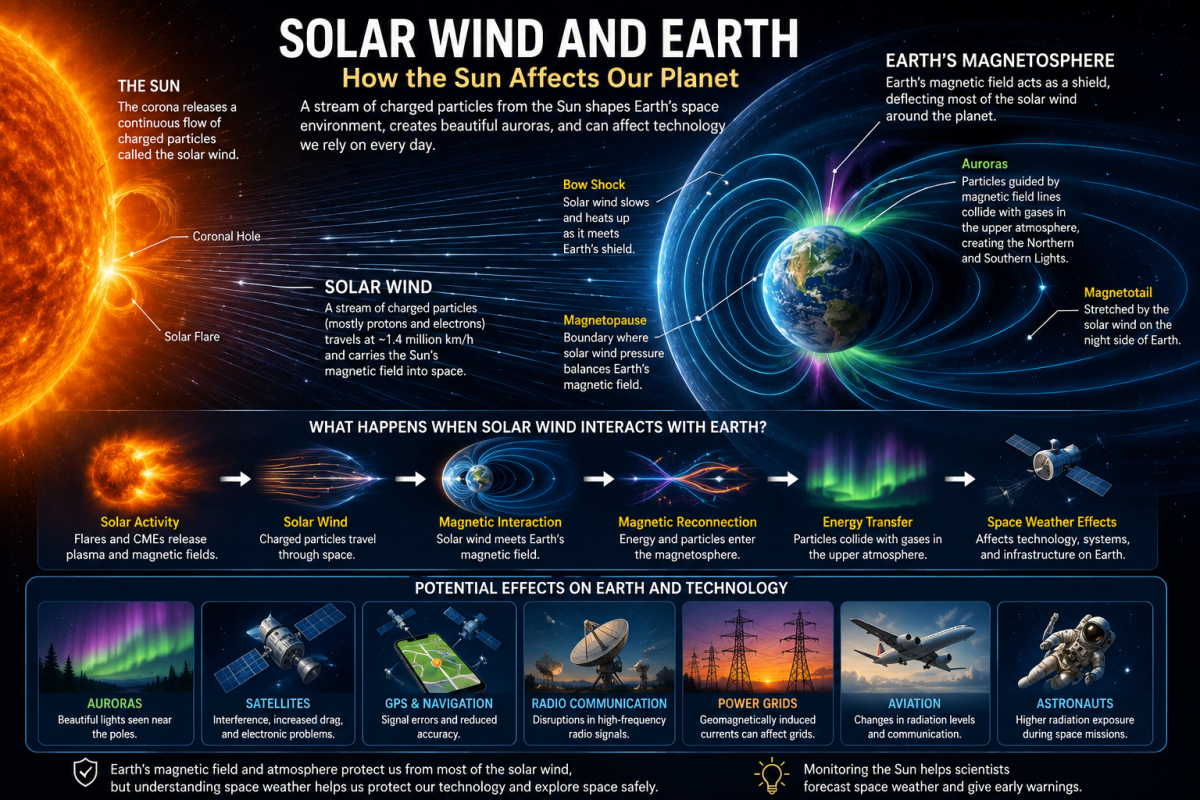
The solar wind is a continuous flow of electrically charged particles moving outward from the Sun. It consists mainly of protons and electrons and carries part of the Sun’s magnetic field into interplanetary space. Near Earth, the solar wind typically travels at roughly 1.4 million kilometers per hour, although its speed can vary considerably.

The solar wind comes from the Sun’s hot outer atmosphere, the corona. Different regions of the corona can produce solar wind with different speeds and densities. Coronal holes are an important source of faster solar-wind streams.

Your article’s basic science can be understood through one simple chain:

Sun → solar wind → Earth’s magnetic field → magnetosphere → upper atmosphere → space weather

That relationship is also central to the JMCCanneyScience research framework, which places the Sun-Earth Connection among its broader space-science topics.

Does Solar Wind Reach Earth?

Yes. The solar wind constantly flows past Earth.

But it does not normally strike Earth’s surface directly.

Earth has a large region of space dominated by its magnetic field called the magnetosphere. This magnetic environment deflects most of the solar wind around the planet. The atmosphere provides another important layer of protection.

A useful way to picture the system is:

Solar wind → magnetosphere → upper atmosphere → limited particle entry

This is why Earth can live under a continuous stream of charged particles without the solar wind simply sweeping away our atmosphere or exposing the surface to all of its energy.

How Does Earth’s Magnetosphere Protect Us?

Earth’s magnetic field creates the magnetosphere, a vast protective region around our planet.

The solar wind compresses the side of the magnetosphere facing the Sun. On the nightside, the magnetic field stretches far outward into a long magnetotail. ESA’s 2026 anatomy of the magnetosphere identifies the major regions involved, including the bow shock, magnetopause, polar cusps, and magnetotail.

The sun-facing boundary, called the magnetopause, forms where the pressure of the solar wind balances the pressure of Earth’s magnetic field. The dayside magnetosphere typically extends about 6–10 Earth radii from the planet, although its shape changes continuously with solar-wind conditions.

Think of the magnetosphere less as a solid wall and more as a dynamic magnetic shield.

It can bend, compress, stretch, reconnect, and release energy as the solar wind changes.

What Happens When Solar Wind Interacts With Earth’s Magnetic Field?

The interaction is not always gentle.

The solar wind carries the interplanetary magnetic field, which can interact with Earth’s magnetic field. When the fields have the right orientation, magnetic reconnection can occur.

Magnetic reconnection allows energy and some charged particles from the solar wind to enter the magnetosphere more effectively. That transferred energy can drive disturbances throughout near-Earth space.

The process can be summarized as:

Solar wind → magnetic interaction → reconnection → energy transfer → magnetospheric activity

This is one of the key processes behind space weather.

How Does Solar Wind Cause Auroras?

Auroras are one of the most beautiful visible effects of the Sun’s interaction with Earth.

During disturbed conditions, some charged particles can travel along Earth’s magnetic field lines toward the polar regions. When these energetic particles interact with gases in the upper atmosphere, they transfer energy to atmospheric atoms and molecules. As those particles return to lower-energy states, they emit light.

The result is the aurora borealis, or Northern Lights, and the aurora australis, or Southern Lights.

Oxygen can produce prominent green and red emissions, while nitrogen contributes blue and purple colors under certain conditions.

That means the aurora is not simply light coming from the Sun.

It is a visible consequence of an interaction between:

Solar particles + magnetic fields + Earth’s upper atmosphere

What Is Space Weather?

Space weather describes changing conditions in near-Earth space caused largely by solar activity and its interaction with Earth’s magnetic environment.

It includes events and disturbances such as:

solar-wind variations
geomagnetic storms
magnetospheric substorms
solar-particle events
effects on the ionosphere and thermosphere

The effects can extend well beyond the aurora.

ESA notes that space weather can affect satellites, astronauts, communications, navigation systems, and electrical infrastructure.

For JMCCanneyScience readers, this connects naturally with the site’s Research Topics, which includes the Sun-Earth Connection – Space & Earth Weather and broader electrical and space-weather topics.

Solar Wind vs. Solar Storm: What’s the Difference?

These terms are related, but they are not interchangeable.

Solar wind

The solar wind is the Sun’s ongoing outflow of charged particles.

Solar storm

A solar storm is a major disturbance in the near-Earth space environment caused by unusually strong solar activity. Large coronal mass ejections (CMEs) can drive powerful disturbances in the solar wind, while solar flares produce intense electromagnetic radiation and can accompany CMEs.

In simple terms:

Solar wind = continuous flow

Solar storm = major disturbance

This distinction is important because not every change in the solar wind produces a major geomagnetic storm.

Solar Wind vs. a Coronal Mass Ejection

A coronal mass ejection, or CME, is a huge eruption of magnetized plasma from the Sun.

The normal solar wind flows continuously, while a CME can produce a much stronger and more organized disturbance when it travels toward Earth. ESA says a CME can create shocks and gusts in the solar wind and may take roughly 18 hours to several days to reach Earth, depending on its speed and trajectory.

So:

Solar Wind CME
Continuous outflow Large eruption
Charged particles and embedded magnetic field Large cloud of magnetized plasma
Varies in speed and density Can produce strong solar-wind disturbances
Constant background of space weather Major driver of some geomagnetic storms

Understanding this difference makes it easier to understand why the Sun can affect Earth every day, while extreme space-weather events are less common.

How Can Solar Wind Affect Satellites?

Satellites operate within or near Earth’s changing magnetic environment, so strong space-weather events can create several problems.

Energetic particles can interfere with or damage spacecraft electronics. Geomagnetic storms can also heat the upper atmosphere, causing it to expand. That increased atmospheric density can increase drag on low-Earth-orbit satellites.

Other effects can include:

satellite charging
electronics anomalies
communication problems
navigation errors
increased orbital drag
higher radiation exposure

Spacecraft outside the strongest protection of Earth’s magnetosphere can face an even harsher environment.

Can Solar Wind Affect GPS and Navigation?

Yes.

Space weather can disturb the ionosphere, the electrically active part of the upper atmosphere through which many radio signals travel.

Changes in the ionosphere can alter how signals propagate, creating errors or reduced reliability in navigation and communication systems. ESA specifically identifies navigation systems among the technologies affected by strong solar events.

This matters because modern society depends on satellite-based positioning for far more than ordinary vehicle navigation.

GPS and related systems support:

aviation
shipping
telecommunications
surveying
timing systems
emergency services
financial and computer networks

The effect therefore goes beyond a temporary GPS inconvenience.

Can Solar Wind Disrupt Radio Communications?

Yes.

Solar activity can disturb the ionosphere and alter how radio waves travel through the upper atmosphere.

Strong solar flares can also release X-rays and ultraviolet radiation that reach Earth much faster than a CME because electromagnetic radiation travels at the speed of light. ESA notes that these emissions can affect short-wave radio communications when they reach the ionosphere.

This is another reason to distinguish:

Solar wind effects

from

solar-flare radiation effects

Both are parts of the broader space-weather system, but they reach and affect Earth’s environment through different mechanisms.

Can Solar Wind Affect Power Grids?

Yes, especially during strong geomagnetic disturbances.

When Earth’s magnetic field changes rapidly, it can induce electric currents in long conducting systems on the ground.

These geomagnetically induced currents can affect infrastructure such as power lines and transformers. NASA specifically notes that strong solar-wind disturbances can compress Earth’s magnetic field and that the resulting changes can affect power-grid infrastructure.

The chain is:

Solar disturbance → changing magnetic field → induced currents → infrastructure effects

This is one reason space weather has become an engineering and infrastructure concern rather than only an astronomy topic.

Does Solar Wind Affect Earth’s Atmosphere?

Yes, but the effect is more complicated than saying that the solar wind simply “blows away” Earth’s atmosphere.

Earth’s magnetosphere deflects most of the solar wind, while the atmosphere provides additional protection. Some solar-wind energy and particles can still enter the near-Earth environment, especially during disturbed conditions.

Over geological timescales, interactions between solar particles and planetary atmospheres can contribute to atmospheric loss.

Earth’s magnetic field gives our planet an important defense against solar-wind-driven erosion. NASA uses Mars as a useful comparison because Mars lacks a strong global intrinsic magnetic field today and has experienced substantial atmospheric loss over its history.

For an in-depth look at JMCCanneyScience’s broader Sun-Earth weather work, the site’s education archive includes a dedicated Weather – Space Weather and the Solar System lecture series, including material on the Sun, space weather, planetary weather, and Earth’s space environment.

Does Solar Wind Affect Humans?

For people on Earth’s surface, the magnetosphere and atmosphere provide substantial protection from the direct effects of the solar wind.

The situation is different for astronauts and spacecraft.

Outside Earth’s protective environment, energetic particles associated with solar activity can create radiation risks. NASA and ESA therefore monitor solar conditions as part of human-spaceflight safety.

So the practical distinction is:

People on Earth → protected by magnetosphere + atmosphere

Astronauts in space → greater exposure

This is one reason future crewed missions beyond low Earth orbit require careful space-weather planning.

Does Solar Wind Affect Earth’s Climate?

This question needs careful treatment.

The Sun affects Earth through many processes, including electromagnetic radiation, solar magnetic activity, and the solar wind. However, solar wind should not be treated as the primary explanation for modern global warming.

Space weather and climate are related to the Sun in different ways and on different timescales.

For a beginner article, the safest distinction is:

Space weather: short-term changes in the Sun-Earth space environment that can affect technology, satellites, auroras, and the upper atmosphere.

Climate: long-term changes in Earth’s climate system influenced by many factors.

JMCCanneyScience’s research takes a broader view of the relationship between the Sun, Earth weather, and electrical conditions in the Solar System. The site’s biography describes McCanney’s work as including the Sun-Earth Connection and Earth Changes, while its research archive lists related weather and space-weather topics.

Those interpretations should be understood as McCanney’s research and theoretical framework, rather than conflated with the mainstream space-weather explanation presented above.

How Does the Solar Cycle Affect the Solar Wind?

Solar activity changes over an approximately 11-year cycle.

During periods of higher activity, the Sun produces more sunspots, flares, CMEs, and other disturbances that can change the space-weather environment around Earth.

Solar-wind conditions can also vary depending on the solar region producing the wind. Fast streams commonly originate from coronal holes, while slower wind is associated with other regions of the corona.

This means Earth’s space environment is never completely static.

The solar wind is always present, but the strength, structure, speed, and embedded magnetic field can change.

How Do Scientists Monitor the Solar Wind?

Scientists use spacecraft and ground-based instruments to monitor:

solar-wind speed
particle density
magnetic-field strength and direction
solar eruptions
ionospheric conditions
geomagnetic activity

Spacecraft positioned between Earth and the Sun can provide valuable warning of incoming disturbances.

ESA notes that missions such as SOHO have monitored the solar wind and CMEs, while newer missions are designed to improve our understanding and forecasting of how the solar wind interacts with Earth’s magnetic environment.

A 2026 development

NASA reported in August 2026 that its PUNCH mission demonstrated a proof-of-concept ability to predict the near-Earth arrival of a solar eruption to within about 30 minutes during an initial test. The result highlights how solar-wind and CME observations are moving toward more useful forecasting.

Better forecasting could provide valuable warning time for satellite operators, power-grid managers, astronauts, and communication networks.

What Happens During an Extreme Solar Storm?

A very strong solar disturbance can affect Earth on several levels at once.

The magnetosphere can compress, currents can intensify, the ionosphere can become disturbed, auroras can expand toward lower latitudes, and technology can experience more severe disruption.

Potential effects include:

satellite anomalies
navigation errors
radio disruptions
increased satellite drag
power-grid stress
radiation risks for astronauts

Researchers are still studying exactly how Earth’s magnetosphere responds to the strongest possible events.

Recent work has questioned whether the apparent limit, or “saturation,” of geomagnetic response during extreme storms is as simple as previously thought. That is an active research question rather than evidence that Earth’s magnetic shield simply fails during a superstorm.

The important message is:

Earth’s magnetosphere is powerful, but it is dynamic rather than invulnerable.

Why Earth’s Magnetic Field Matters

The relationship between the Sun and Earth is not simply a story of the Sun bombarding a passive planet.

Earth actively responds.

The planet’s magnetic field creates a magnetosphere that:

deflects most solar-wind particles,
shapes the way energy enters near-Earth space,
contributes to atmospheric protection,
channels charged particles toward the poles,
and helps determine how space weather reaches the ionosphere.

NASA describes the magnetosphere as a key part of Earth’s habitability and protection against solar and cosmic particle radiation.

ESA’s 2026 magnetosphere overview also shows how the bow shock, magnetopause, polar cusps, auroral regions, and magnetotail work together as parts of one dynamic system.

Solar Wind and Earth: The Bigger Picture

The solar wind is much more than a stream of particles traveling through empty space.

It is part of a connected Sun-Earth system.

The overall process looks like this:

Sun

Corona and solar magnetic activity

Solar wind and solar disturbances

Interplanetary magnetic field

Earth’s magnetosphere

Magnetic reconnection and energy transfer

Ionosphere and upper atmosphere

Auroras and space weather

Effects on satellites, GPS, radio, power systems and other technology

That chain explains why scientists study the solar wind not only to understand the Sun, but also to understand Earth’s space environment and protect modern technology. NASA and ESA both describe space weather as an important connection between solar activity and systems on Earth and in space.

Solar Wind and JMCCanneyScience Research

JMCCanneyScience has a broader body of research focused on the Sun-Earth Connection, space weather, Earth weather, magnetic fields, and electrical processes in the Solar System.

Its Research Topics page specifically lists “The Solar System Sun-Earth Connection – Space & Earth Weather” along with related research topics.

The site’s Science Education K-12/University Program also includes a dedicated Weather – Space Weather and the Solar System lecture series covering the Sun, planetary weather, space weather, and Earth’s space environment.

McCanney’s Biography also describes his work as including the connection between the Sun, Earth weather, the Sun-Earth Connection, and Earth changes.

These pages present McCanney’s research and theoretical interpretations. The mainstream solar-wind and space-weather explanation in this article is based on NASA and ESA sources and should not be treated as identical to McCanney’s proposed framework.

Frequently Asked Questions
What is solar wind?

Solar wind is a continuous flow of charged particles, mainly protons and electrons, released by the Sun’s outer atmosphere.

Does solar wind reach Earth?

Yes. Solar wind constantly reaches Earth’s neighborhood, but Earth’s magnetosphere deflects most of the particles around the planet.

Does Earth’s magnetic field block solar wind?

It deflects most of it rather than acting like a solid wall. Some energy and particles can enter the magnetosphere, especially during disturbed conditions.

How does solar wind affect Earth?

It interacts with Earth’s magnetosphere and can produce auroras, geomagnetic storms, ionospheric disturbances, and effects on satellites, navigation, communications, and power infrastructure.

Does solar wind cause the Northern Lights?

Yes. Solar-wind particles can be guided toward Earth’s polar regions, where interactions with upper-atmosphere gases produce auroras.

Can solar wind damage satellites?

Strong space-weather events can expose satellites to energetic particles, increase atmospheric drag on low-orbit spacecraft, and interfere with electronics and communications.

Can solar wind cause power outages?

Strong geomagnetic disturbances can induce currents in electrical infrastructure and contribute to problems in power-grid systems.

Does solar wind affect GPS?

Yes. Solar-driven disturbances in the ionosphere can affect radio propagation and reduce the accuracy or reliability of satellite navigation systems.

Is solar wind the same as a solar storm?

No. Solar wind is the Sun’s continuous flow of charged particles. A solar storm is a significant disturbance in the solar and near-Earth environment, often associated with events such as CMEs.

What is the difference between solar wind and a CME?

The solar wind is an ongoing flow of particles. A CME is a large eruption of magnetized plasma that can create a strong disturbance in that flow.

Can solar wind strip Earth’s atmosphere?

The solar wind can contribute to atmospheric loss, but Earth’s magnetic field provides substantial protection. The long-term history of atmospheric loss on planets such as Mars illustrates why planetary magnetic environments matter.

Final Takeaway

Solar wind and Earth are connected through one of the most important interactions in space science.

The Sun continuously sends charged particles into the Solar System. When that flow reaches Earth, it encounters our planet’s magnetic field and forms a dynamic magnetosphere.

Most of the solar wind is deflected.

Some of its energy and particles can enter the magnetosphere and interact with the ionosphere and upper atmosphere, producing auroras and other forms of space weather.

During stronger disturbances, the same Sun-Earth connection can affect:

satellites → GPS → radio communications → aviation → power systems → astronauts

This is why the solar wind matters even though people on Earth’s surface rarely feel it directly.

The Sun is constantly interacting with our planet, and Earth’s magnetic field is one of the key systems that determines how that interaction unfolds.

Explore More JMCCanneyScience Research

For a deeper look at the site’s work on the Sun-Earth Connection, space weather, Earth weather, and related Solar System research, explore the Research Topics and Science Education K-12/University Program.

For readers interested in McCanney’s broader work on the relationship between the Sun, Earth weather, and Earth changes, the site’s Biography provides additional context.

Comet vs Asteroid: The Quick Answer

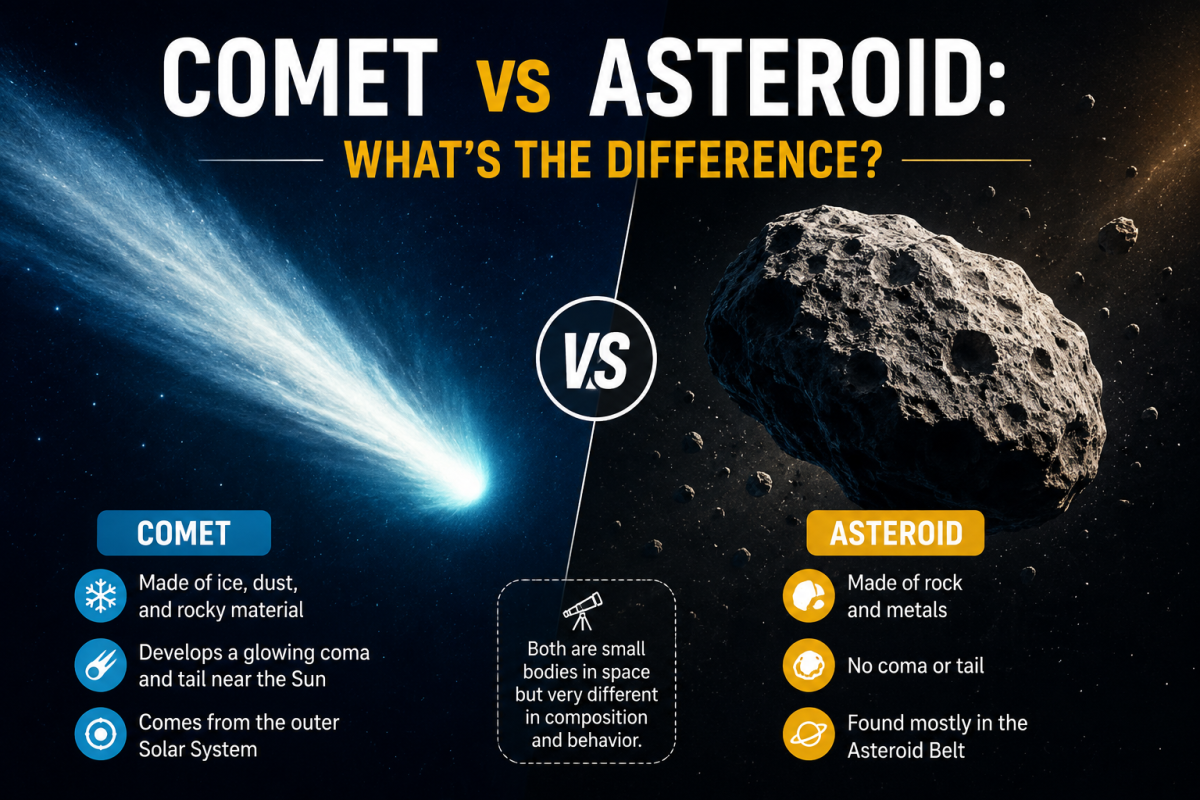
Both comets and asteroids are small bodies left over from the formation of the Solar System, but they differ mainly in composition and behavior.

A comet contains substantial ice and volatile material mixed with dust and rocky material. When a comet approaches the Sun, solar heating can cause some of its volatile material to escape, producing a coma and, when conditions are right, a visible tail.

An asteroid is generally a rocky or metallic body that does not normally develop a coma or tail. Most asteroids are found in the main asteroid belt between Mars and Jupiter, although many also occupy other orbits.

The simplest comparison is:

Comet → ice + dust + rock → can become active near the Sun

Asteroid → mainly rock and/or metal → usually remains inactive

But that is only the starting point. Some asteroids can show comet-like activity, and some cometary bodies can become difficult to distinguish from asteroids.

Comet vs Asteroid at a Glance
Feature Comet Asteroid
Main composition Ice, dust, rock, volatile materials Mostly rock and/or metal
Formation environment Predominantly colder regions of the early Solar System Predominantly warmer rocky regions
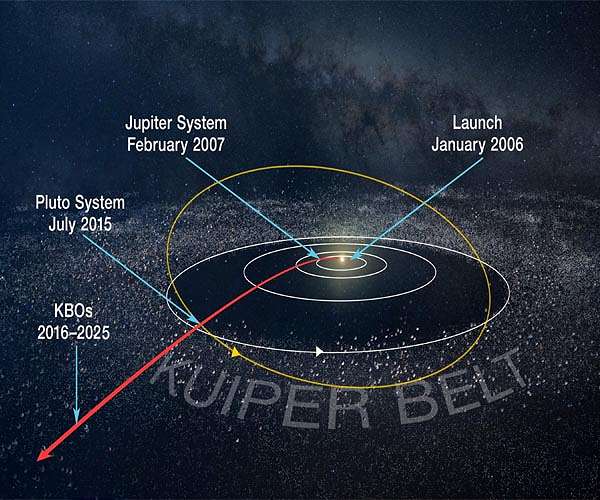
Typical locations Kuiper Belt, Oort Cloud, and related comet reservoirs Mainly the asteroid belt, plus near-Earth and other populations
Activity near the Sun Can release gas and dust Usually little or no visible activity
Coma Can develop one Normally absent
Tail Can develop one or more tails Usually absent
Appearance in a telescope Can become fuzzy when active Often appears as a point of light
Orbit Can be highly elongated Can have many different orbital shapes
Important exceptions Dormant or depleted comets Active asteroids

The important word in this table is usually. Neither category follows a single rule in every case.

What Is a Comet?

A comet is a small Solar System body that contains ice, dust, rock, and volatile compounds.

Its solid center is called the nucleus. When a comet remains far from the Sun, much of its volatile material stays frozen and the object can appear relatively inactive.

As it moves into the inner Solar System, increasing sunlight heats its surface. Volatile material can then sublimate, changing directly from solid to gas.

The escaping material forms a cloud around the nucleus called the coma. Dust and electrically charged gas can then be shaped by sunlight and the solar wind to create comet tails.

For a more detailed explanation of this process, see Why Do Comets Have Tails?.

What Are Comets Made Of?

Comet nuclei contain mixtures of:

water ice and other frozen volatiles
dust
rocky material
organic compounds
gases such as carbon monoxide and carbon dioxide

The exact composition varies between comets.

This mixture is important because it explains why comets can become active when they approach the Sun.

What Is an Asteroid?

An asteroid is a relatively small natural body that orbits the Sun and is generally dominated by rocky or metallic material.

Asteroids come in many shapes and sizes. Some are irregular, some are relatively rounded, and some have moons of their own. NASA notes that most asteroids are located in the asteroid belt between Mars and Jupiter, but asteroids also exist in near-Earth and other populations.

Unlike an active comet, an ordinary asteroid does not usually develop a large coma and tail when it approaches the Sun.

That does not mean asteroids are always completely inactive. Some can eject particles, develop dust, or otherwise show unusual activity.

Why Are Comets Icy but Asteroids Usually Rocky?

The difference starts with where these bodies formed.

The early Solar System contained a disk of gas and dust around the young Sun. Temperatures were much higher close to the Sun and much colder farther away.

Farther from the Sun, water and other volatile compounds could remain frozen. Those colder regions provided an environment where icy bodies could form and survive.

Closer to the Sun, temperatures made it much harder for volatile ices to remain stable at the surface.

That is why many comets are associated with colder outer regions, while the main asteroid belt contains mostly rocky bodies. NASA identifies the Kuiper Belt beyond Neptune and the distant Oort Cloud as major comet reservoirs, while the asteroid belt occupies the region between Mars and Jupiter.

So rather than memorizing “comets are ice and asteroids are rock,” it is more useful to remember:

Formation environment → temperature → materials that could remain stable → composition

Where Are Comets and Asteroids Found?
Where Are Comets Found?

Many comets originate in the colder outer Solar System.

Short-period comets are commonly associated with the Kuiper Belt, beyond Neptune. Many take less than about 200 years to orbit the Sun.

Long-period comets are associated with the much more distant Oort Cloud, a huge reservoir surrounding the Solar System.

Gravitational interactions can change a comet’s orbit and send it toward the inner Solar System.

Where Are Asteroids Found?

The largest concentration of known asteroids lies in the main asteroid belt between Mars and Jupiter. However, asteroids also occupy near-Earth orbits, Trojan populations, and other regions of the Solar System.

So location provides a useful clue, but it does not define every object.

How Are Comet and Asteroid Orbits Different?

People often say that comets have highly elliptical orbits while asteroids have more circular orbits.

That is a useful generalization, but it is not a strict rule.

Many comets do travel on highly elongated orbits that carry them far from the Sun before bringing them back through the inner Solar System.

Asteroids have a much wider range of orbital shapes. Many main-belt asteroids have relatively modest eccentricities, but near-Earth asteroids and other populations can have substantially different orbits.

For this reason, orbit alone cannot always tell you whether an object is a comet or an asteroid.

The object’s composition and physical activity also matter.

Why Do Comets Develop Tails?

This is one of the clearest visible differences between an active comet and a typical asteroid.

When a comet approaches the Sun, heat can cause volatile material to sublimate from its nucleus. Escaping gas can carry dust away from the surface and create the coma.

Solar radiation and the solar wind then interact with that material.

A comet can develop a dust tail and an ion tail, which usually extend generally away from the Sun.

That is why a comet can suddenly become much brighter and more visually impressive as it approaches the Sun.

A typical asteroid does not have the same inventory of readily accessible volatile material, so it normally does not produce a classic cometary coma and tail.

Do Asteroids Ever Have Tails?

Yes.

This is an important exception because it shows that the comet-versus-asteroid boundary is not perfectly rigid.

NASA’s observations of 3200 Phaethon are a good example. Phaethon is classified as an asteroid and is associated with the Geminid meteor shower, but observations have found comet-like behavior, including a faint tail. NASA research suggests that sodium vapor released from the intensely heated asteroid may help explain this activity.

Scientists often use the term active asteroid for asteroid-like objects that display activity.

Phaethon is therefore especially useful because it demonstrates that:

A tail does not automatically mean that an object is a traditional comet.

The physical mechanism behind the activity matters.

Can a Comet Become Asteroid-Like?

Yes.

A comet repeatedly passing close to the Sun can gradually lose volatile material from its surface.

As the accessible volatile material becomes depleted, the comet may become much less active. Its coma and tail can weaken or disappear, making the object look more like an asteroid.

Astronomers use terms such as dormant comet or extinct comet for different stages or interpretations of this kind of evolution.

This creates an important connection between the two categories:

Active comet → repeated solar heating → volatile loss → reduced activity → asteroid-like appearance

That is one reason scientists sometimes cannot determine an object’s history from its appearance alone.

Comet vs Asteroid: Which Is Bigger?

There is no simple size rule.

Both comets and asteroids exist across a broad range of sizes, and their populations overlap.

For example, NASA has observed relatively small comet nuclei and enormous asteroids such as Ceres.

So statements like “asteroids are bigger than comets” or “comets are smaller than asteroids” are misleading.

Size can help describe an individual object, but it does not provide a reliable definition of the category.

What Do Comets and Asteroids Have in Common?

Despite their differences, comets and asteroids share a great deal.

Both:

orbit the Sun,
are small compared with planets,
formed from material associated with the early Solar System,
preserve information about planetary formation,
can interact gravitationally with planets,
can enter near-Earth orbits,
and can produce smaller fragments.

NASA describes both asteroids and comets as leftovers from the formation of the Solar System about 4.6 billion years ago.

They are therefore not completely separate kinds of worlds. They are part of a broader population of small Solar System bodies.

Comet vs Asteroid vs Meteoroid vs Meteor vs Meteorite

These terms are often confused.

A meteoroid is a small piece of rock or metal traveling through space. It can originate from an asteroid, a comet, or another body.

When a meteoroid enters Earth’s atmosphere and produces the bright streak commonly called a shooting star, we call the phenomenon a meteor.

If some of the material survives atmospheric entry and reaches the ground, it becomes a meteorite.

The sequence is:

Asteroid or comet → fragment → meteoroid → atmosphere → meteor → surviving material → meteorite

Comets can also leave debris streams that produce meteor showers when Earth crosses them.

Are Comets or Asteroids More Dangerous to Earth?

Neither is automatically more dangerous.

Potential impact risk depends on an object’s:

size,
orbit,
speed,
composition,
and probability of encountering Earth.

Both asteroids and comets can enter near-Earth space.

NASA and JPL track near-Earth objects and calculate their orbits to evaluate possible close approaches and impact risks.

The important point is that classification alone does not determine danger.

Why the Comet-Asteroid Boundary Is Not Always Clear

Modern observations have made the old textbook distinction less absolute.

A typical comet is icy and can become active near the Sun.

A typical asteroid is rocky and generally remains inactive.

But nature produces exceptions.

Some asteroids show tails or eject dust. Some cometary bodies lose much of their volatile material and become asteroid-like. Other unusual objects can share physical characteristics of both groups.

That is why modern astronomy increasingly looks at an object’s composition, activity, orbit, and evolution together, rather than relying on one simple visual label.

A Broader Look at Comet Research

JMCCanneyScience contains a large body of research focused on comets, the Solar System, and space science.

Readers who want to explore the site’s wider material can visit Research Topics, which includes topics such as the Plasma Discharge Comet Model and other Solar System research.

For McCanney’s broader comet-related work, Planet X, Comets and Earth Changes provides another relevant starting point.

The site’s Comets material provides a more direct route for readers interested specifically in comet research.

These pages represent McCanney’s own research and proposed interpretations. They should be distinguished from the mainstream astronomical explanations used in the comparison above.

Frequently Asked Questions
What is the main difference between a comet and an asteroid?

Comets contain substantial volatile and icy material and can become active near the Sun, while asteroids are generally rocky or metallic and usually remain inactive.

Are comets made of ice?

Yes. Comets contain ice and other volatile materials mixed with dust and rocky material.

Are asteroids made of metal?

Some asteroids contain substantial metal, while others are dominated by rock or carbon-rich material. Asteroids are not all made from the same composition.

Why do comets have tails?

Solar heating causes volatile material to escape from a comet. The released gas and dust can then be shaped by sunlight and the solar wind into tails.

Can an asteroid have a tail?

Yes. Some active asteroids, including Phaethon, can produce comet-like activity.

Where do most asteroids come from?

Most known asteroids are concentrated in the main asteroid belt between Mars and Jupiter, although many occupy other orbits.

Where do comets come from?

Many short-period comets are associated with the Kuiper Belt, while many long-period comets are associated with the Oort Cloud.

Are asteroids and comets the same thing?

No, but they share a common history as remnants of Solar System formation, and some objects blur the traditional distinction.

What is the difference between a meteoroid, meteor, and meteorite?

A meteoroid is the object in space. A meteor is the visible event when it enters an atmosphere. A meteorite is material that survives and reaches the ground.

The Bottom Line

The difference between a comet and an asteroid comes down primarily to composition, formation environment, and how each object behaves when exposed to the Sun.

Comets contain significant ice and volatile material. When they approach the Sun, that material can escape and create a coma and tail.

Asteroids are generally rocky or metallic and usually remain relatively inactive.

But the distinction is not absolute.

Active asteroids can produce comet-like activity, while dormant or depleted comets can become difficult to distinguish from asteroids.

So the best way to understand the difference is not simply:

Comets = ice. Asteroids = rock.

A better explanation is:

Comets and asteroids are both ancient small bodies from the early Solar System, but differences in composition and formation environment give them different behavior—while some unusual objects show that the boundary between the two is not always sharp.

Interested in Learning More About This Research?

If you would like to explore more about comets, Solar System research, McCanney’s publications, or available consulting services, contact us to discuss your questions.

Call Now: 612-232-6651

What Is a Dark Comet?

A dark comet is a small Solar System object that looks like an asteroid but shows comet-like behavior in its motion, even though it may not display the obvious coma or tail normally associated with an active comet. NASA describes dark comets as objects that look like asteroids but act like comets.

The key clue is an unusual change in the object’s motion called nongravitational acceleration. In simple terms, astronomers find that the object is not following the path they would expect from gravity alone.

One possible explanation is weak outgassing: volatile material may escape from the surface and produce a tiny recoil force.

So the simplest definition is:

A dark comet looks like an asteroid, but its motion can reveal hidden comet-like activity.

Why Are Dark Comets Called “Dark”?

“Dark” does not necessarily mean that a dark comet is literally black.

The name mainly refers to its lack of obvious visible cometary activity. A normal active comet can develop a bright coma and tail when material escapes from its nucleus. A dark comet may remain a point of light in telescope images even while its orbit shows an unusual acceleration.

This makes dark comets difficult to identify using appearance alone.

Dark Comet vs. Asteroid vs. Normal Comet
Feature Asteroid Active Comet Dark Comet
Appearance Usually asteroid-like Can develop a coma and tail Usually asteroid-like
Visible activity Usually absent Often visible when active Weak or not obvious
Motion Primarily modeled through gravity and known forces Can change because of outgassing Shows measurable nongravitational acceleration
Main mystery — Visible comet activity Comet-like motion without obvious activity

The important distinction is that a dark comet is not simply a very dark asteroid. Its unusual orbital behavior is what makes it scientifically interesting.

What Is Nongravitational Acceleration?

The term sounds complicated, but the idea is simple.

Astronomers use observations to calculate an object’s orbit. They then compare the predicted position with where the object actually appears.

If repeated measurements show that the object is slightly deviating from its expected gravitational path, researchers look for another force.

That additional change in motion is called nongravitational acceleration.

For dark comets, this is one of the most important clues because it suggests that something besides ordinary gravity is affecting the object.

What Could Cause the Acceleration?

One leading explanation is outgassing.

Some comets contain volatile material that can turn into gas when heated by the Sun. When gas escapes from a small body, it carries momentum with it. The escaping material can therefore produce a small recoil force.

Think of it as a very weak natural rocket:

volatile material → gas escapes → recoil force → small change in motion

For an ordinary comet, this process can produce an obvious coma or tail.

For a dark comet, the activity may be weak enough that astronomers can measure its effect on the orbit without immediately seeing the material escaping.

That explanation is still being investigated for individual objects; scientists do not assume that every dark comet has exactly the same mechanism.

Why Don’t Dark Comets Have Obvious Tails?

That is one of the main questions behind dark-comet research.

A dark comet could potentially release such a small amount of material that the resulting coma or tail remains below the detection limit of earlier observations. Activity could also be localized or contain little visible dust.

Recent observations are making this question especially interesting.

In July 2026, Nature Astronomy reported the detection of a cometary tail on a near-Earth object whose comet-like nongravitational acceleration had already suggested hidden activity.

NASA also reported in July 2026 that 1998 SH2, previously treated as an asteroid, was shown to be a comet after observations detected weak cometary activity.

These discoveries show why orbital measurements can be important even when a cometary tail is not immediately visible.

How Are Dark Comets Detected?

Scientists can identify potential dark comets through precise position measurements and orbital calculations.

The process is straightforward:

A telescope detects a small object.
Astronomers measure its position over time.
Researchers calculate its orbit.
New observations test whether the object follows the predicted path.
Any persistent unexplained acceleration is investigated.
Astronomers search for faint coma, dust, or tail activity.

This means a dark comet can be recognized through how it moves, not just through what it looks like.

The 2026 work on 1998 SH2 is a good example of how improved tracking and more sensitive observations can change our understanding of an object.

Are There Different Types of Dark Comets?

Yes. NASA’s 2024 research identified two broad populations of dark comets.

Inner Dark Comets

Inner dark comets are smaller objects found in the inner Solar System. NASA describes them as generally tens of meters or less in size and moving in nearly circular orbits.

Outer Dark Comets

Outer dark comets are larger and follow more eccentric or elongated orbits. NASA describes them as hundreds of meters or more across, with orbital characteristics resembling Jupiter-family comets.

The two populations suggest that dark comets may not all share the same history.

Where Do Dark Comets Come From?

Scientists do not yet have one confirmed answer.

Researchers are examining several possibilities, including connections with the main asteroid belt, comet-like populations, and evolutionary processes that can change small bodies over time.

A 2024 Icarus study explored possible evolutionary pathways involving rotational fragmentation and the ν6 resonance. These are useful research concepts, but they should be treated as hypotheses under investigation rather than as a final explanation for every dark comet.

For readers who want to explore broader comet questions and McCanney’s work, visit the Comets section of JMCCanneyScience.

Is ʻOumuamua a Dark Comet?

No.

ʻOumuamua was the first confirmed interstellar object observed passing through our Solar System. It is not classified as a confirmed dark comet.

However, its unusual motion and lack of obvious cometary activity helped researchers think more deeply about objects that can show unexplained nongravitational behavior. NASA specifically describes ʻOumuamua as an important object for understanding the dark-comet phenomenon, rather than as a dark comet itself.

What Do We Know About Dark Comets?

The strongest evidence is observational.

Scientists have identified small bodies that:

look like asteroids,
show unusual nongravitational motion,
often lack an obvious coma or tail,
and may represent weakly active or otherwise unusual cometary bodies.

NASA’s 2024 study reported 14 known dark comets at that time and identified two broad populations. By 2026, NASA described the known population more generally as about a dozen while highlighting new work on objects such as 1998 SH2.

This difference in wording reflects an evolving research field, so it is better to use “14 identified in the 2024 study” than to present 14 as a permanent current total.

What Scientists Still Don’t Know

Dark-comet research is still developing.

Scientists are continuing to investigate:

exactly what causes the acceleration,
how much volatile material these objects contain,
why some show no obvious activity,
where the different populations originated,
and how many apparently inactive near-Earth objects may actually have weak cometary activity.

NASA has also raised the possibility that dark comets could have contributed materials relevant to the development of life on Earth. That remains a research question, not an established history of delivery.

Dark Comets and JMCCanneyScience Research

JMCCanneyScience has a substantial body of work focused on comets and the electrical nature of the Solar System.

Readers interested in the site’s broader research can explore Comet Research and Research Topics, including the site’s Plasma Discharge Comet Model.

For McCanney’s broader comet-related publications, see Planet X, Comets and Earth Changes.

These pages present McCanney’s research and proposed interpretations. They should be distinguished from the mainstream scientific research summarized in the sections above.

The Bottom Line

A dark comet is an unusual small Solar System object that looks like an asteroid but shows comet-like behavior through its motion.

The most important clue is nongravitational acceleration.

One leading explanation is weak outgassing, where volatile material escapes from the surface and produces a small recoil force. But researchers are still studying the exact causes, origins, and physical properties of these objects.

Recent 2026 observations show why the subject matters: an object can appear inactive at first and later reveal weak cometary activity when astronomers combine precise orbital tracking with more powerful observations.

Dark comets therefore challenge a simple classification:

Some objects look like asteroids but may hide cometary behavior that only their motion reveals.

Frequently Asked Questions
What is a dark comet?

A dark comet is an asteroid-like object that shows measurable comet-like nongravitational motion without an obvious coma or tail.

Is a dark comet black?

Not necessarily. “Dark” mainly refers to the lack of obvious visible cometary activity.

What is the difference between a dark comet and an asteroid?

A dark comet can look like an asteroid but show an unexplained change in its motion that may be associated with comet-like activity.

What causes dark-comet acceleration?

Weak outgassing is one leading explanation, although researchers are still investigating the cause for individual objects.

How are dark comets detected?

Astronomers combine precise position measurements, orbital calculations, long-term tracking, and searches for faint cometary activity.

How many dark comets are known?

NASA reported 14 identified dark comets in its December 2024 study. The number and classification of known objects can change as researchers make new observations.

Are inner and outer dark comets different?

Yes. NASA’s 2024 research identified smaller inner objects with nearly circular orbits and larger outer objects with more eccentric orbits.

Is ʻOumuamua a dark comet?

No. It is an interstellar object that helped researchers understand the phenomenon but is not classified as a confirmed dark comet.

Interested in Learning More About This Research?

If you would like to learn more about McCanney’s research, comet-related research, publications, or available consulting services, contact us to discuss your questions.

Call Now: 612-232-6651

JMCCanneyScience also lists Consulting in its main Space Program navigation for readers interested in discussing research and technical subjects.

Why Do Comets Have Tails?

Comets are among the most recognizable objects in the Solar System because of their bright, extended tails. But a comet does not carry a permanent tail through space. Its tail develops when the comet approaches the Sun and its frozen, volatile material begins responding to solar energy.

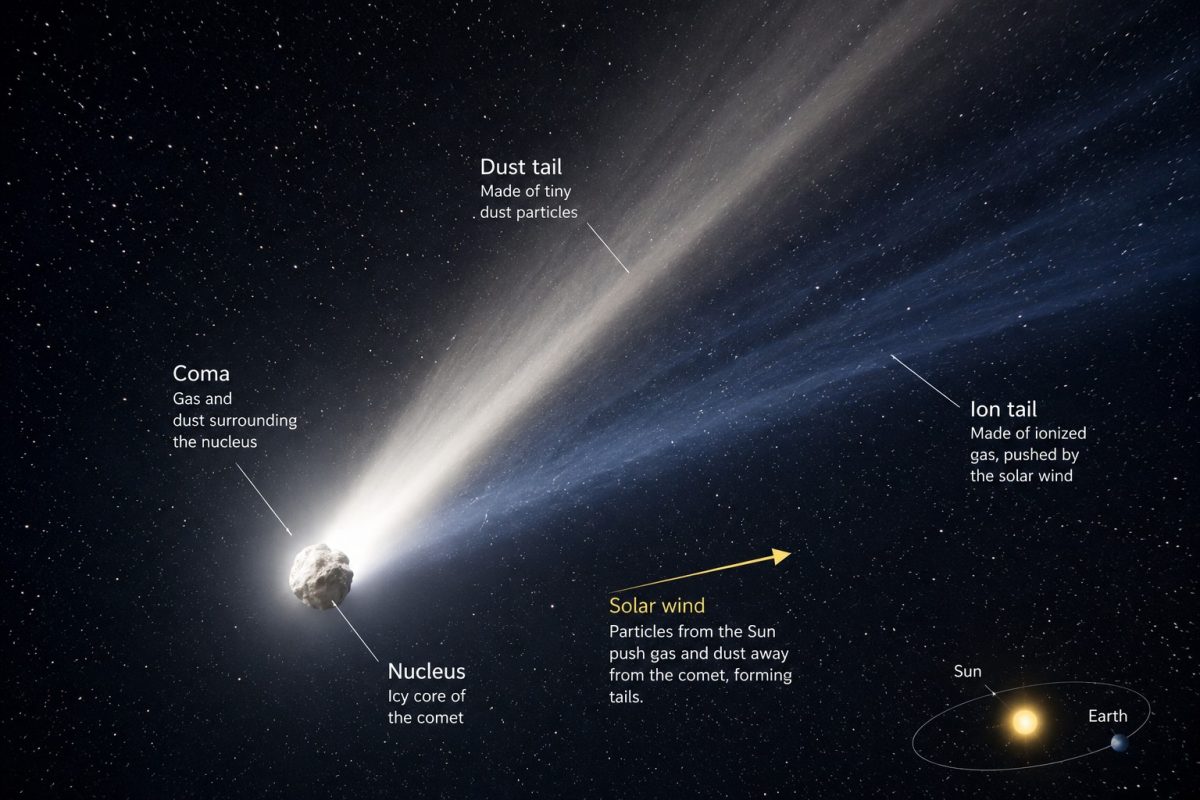
As a comet moves into the warmer regions of the inner Solar System, sunlight heats its nucleus. Ice and other volatile substances escape from the surface as gas, carrying dust with them. This creates a surrounding cloud called the coma. Solar radiation pressure and the solar wind then act on the material released from the comet, producing the structures we see as comet tails.

Most visible comets show two major tails:

a dust tail, made primarily of solid dust particles
an ion tail, also called a plasma tail, made of electrically charged gas

These tails form through different physical processes, which is why they can have different colors, shapes, and directions.

The most important point is this:

A comet’s tail does not simply trail behind the comet because it is moving through space. The Sun actively shapes the material around the comet.

That distinction explains why a comet can sometimes have a tail that points in a direction that looks completely wrong relative to its motion.

What Is a Comet Made Of?

Before understanding a comet’s tail, it helps to understand the comet itself.

A comet has a solid central body called the nucleus. NASA describes comet nuclei as containing ice, frozen gases, and embedded dust. Those materials stay relatively inactive when the comet remains far from the Sun.

Comet material can include:

water ice
frozen gases and other volatile compounds
dust
rocky material
organic compounds
small solid particles

The word volatile refers to substances that can change readily from a solid or liquid state into gas under relatively low temperatures.

A comet therefore behaves differently from an asteroid. An asteroid is generally dominated by rock or metal, while a comet contains a significant inventory of volatile material that can become active when solar heating increases.

You may also encounter the classic phrase “dirty snowball,” a description associated with the traditional model of a comet nucleus. The expression is useful as a simple analogy, but an actual comet is more complicated than an ordinary snowball made from clean water ice. Space missions have shown that comet nuclei have complex, dark, dusty and chemically varied surfaces.

For a deeper look at comet structure, see Geology of Comets.

What Happens When a Comet Approaches the Sun?

The Sun is the key to understanding comet activity.

A comet that spends most of its orbit in the cold outer Solar System may show little or no obvious tail. As it travels toward the inner Solar System, increasing sunlight warms its surface.

The change is especially important near perihelion, the point in a comet’s orbit where it passes closest to the Sun.

As solar energy reaches the nucleus, volatile material can sublimate. Sublimation occurs when a substance changes directly from a solid into gas without first becoming a liquid.

In a comet, this process releases gas from the surface and subsurface regions. Escaping gas can drag dust particles outward with it, creating an expanding cloud around the nucleus. That cloud is the coma.

So the sequence is:

Sunlight → heating → sublimation → escaping gas and dust → coma → tails

The closer and more active the comet becomes, the more dramatic this process can appear.

What Is a Comet’s Coma?

The coma is the large envelope of gas and dust surrounding the comet’s nucleus.

It forms when material escaping from the nucleus expands into space. The coma can become vastly larger than the solid nucleus itself, and it is often the first major sign that a previously faint comet has become active.

The coma is important because the tail does not appear from nowhere. The comet first releases material into its surrounding environment. Solar radiation and the solar wind then interact with that material and organize some of it into extended tails.

In other words, the coma is the source region from which the visible tail develops.

How Does a Comet Tail Form?

A comet tail forms when material released from the nucleus is acted upon by the Sun.

Two major solar effects are especially important:

Solar radiation pressure acts on dust.

The solar wind interacts strongly with charged particles and helps shape the ion tail.

Solar ultraviolet radiation also contributes to the ionization of gas molecules around an active comet. Once gas becomes electrically charged, it behaves as plasma and interacts with the electromagnetic environment around the Sun.

This produces two distinct tail structures.

What Are the Two Types of Comet Tails?
1. The Dust Tail

The dust tail contains small solid particles released from the comet.

Sunlight exerts a tiny but real pressure on those particles. This is called radiation pressure. Each photon of light carries momentum, and when sunlight interacts with matter, it can transfer some of that momentum to the material.

For a microscopic dust particle, the effect is small. But enormous numbers of particles are involved, and the particles remain exposed to sunlight as the comet travels around the Sun.

The result is a broad, diffuse tail that often appears white or yellowish because the dust reflects sunlight.

2. The Ion Tail

The ion tail, also called the plasma tail, consists of electrically charged particles.

Solar ultraviolet radiation can ionize gas released by the comet. The resulting ions interact strongly with the solar wind and the magnetic field carried by that wind.

The ion tail is typically narrower and more sharply directed than the dust tail. It often appears blue because some of the ionized molecules emit light through fluorescence.

Dust Tail vs. Ion Tail
Feature Dust Tail Ion Tail
Main material Dust particles Ionized gas
Major solar influence Radiation pressure Solar wind and electromagnetic effects
Typical appearance Broad and curved Narrow and straighter
Typical color White or yellowish Often blue
Relationship to comet orbit More strongly shaped by orbital motion More directly aligned away from the Sun

These are not two versions of the same tail. They are two different populations of material responding differently to the solar environment.

Why Does a Comet’s Tail Point Away From the Sun?

This is one of the most important questions in comet science.

Many people naturally assume that a comet’s tail should point behind it, like the wake behind a boat. But space does not work that way.

There is essentially no atmosphere producing ordinary air resistance around a comet. Instead, the tail forms because solar forces act on material around the comet.

The ion tail points away from the Sun because the solar wind carries charged particles and magnetic fields outward from the Sun. The charged gas released by the comet becomes part of this interaction and forms a tail that generally points in the anti-solar direction.

The dust tail is also pushed generally away from the Sun by radiation pressure, but dust particles are heavier and remain strongly influenced by gravity and their orbital motion. That is why the dust tail usually appears curved rather than perfectly straight.

Does a Comet’s Tail Always Trail Behind It?

No.

A comet’s tail does not necessarily point opposite the direction in which the comet is traveling.

Its direction is governed primarily by its relationship with the Sun and by the forces acting on the released material.

This means a comet traveling away from the Sun can have its tail extending in front of it rather than behind it. ESA specifically notes that this can happen because the tail points away from the Sun rather than simply opposite the comet’s direction of travel.

That single fact resolves one of the most common misconceptions about comet tails.

Why Is the Dust Tail Curved?

The dust tail is curved because dust particles do not respond to solar radiation in exactly the same way as the much lighter ions in the ion tail.

Each dust particle remains under the influence of the Sun’s gravity while radiation pressure pushes it outward. At the same time, the particle retains orbital motion inherited from the comet.

Different dust particles can also have different sizes and therefore respond differently to radiation pressure.

The result is a broad, curved structure rather than a narrow straight line. NASA explains that relatively massive dust particles accelerate more slowly and remain more strongly influenced by orbital motion, producing a curved dust tail.

This is why photographs of bright comets often show the dust tail bending gently away from the comet’s path.

For more on Comet Orbital Dynamics, see Comet Orbital Dynamics.

Why Is the Ion Tail Straighter?

The ion tail consists of particles that are far lighter and electrically charged.

Once the gas becomes ionized, the solar wind and the electromagnetic environment surrounding the Sun can strongly influence its motion. As a result, the ion tail tends to form a narrow structure pointing away from the Sun.

The two tails can therefore separate visibly:

Dust: broad, curved, reflective

Ions: narrow, straighter, often bluish

This difference provides a striking demonstration of how different physical forces act on different forms of matter in space.

What Is Solar Wind?

The solar wind is a continuous flow of charged particles from the Sun.

It includes particles such as protons and electrons and carries magnetic fields outward through the Solar System.

When an active comet enters this environment, the solar wind interacts with the ionized material surrounding the comet. That interaction helps create and shape the ion tail.

The solar wind is therefore an essential part of comet-tail physics.

It also explains why the comet’s environment cannot be understood by thinking only about sunlight and heat. A comet is moving through a dynamic electromagnetic environment created by the Sun.

For related material on the relationship between the Sun and the surrounding Solar System, see the Sun-Earth Connection.

How Does Sunlight Push Dust in Space?

It may seem strange that light can push something, but photons carry momentum.

When sunlight strikes a dust particle, the interaction can transfer momentum to that particle. This creates a small force known as radiation pressure.

For a large object, the effect is usually tiny. But comet tails contain enormous numbers of very small particles, making the cumulative effect visible on astronomical scales.

Radiation pressure does not make the dust instantly shoot away in a perfectly straight line. Solar gravity and the dust particle’s orbital motion remain important. The combined effects produce the characteristic broad and curved dust tail.

Why Do Comets Have Tails Only Near the Sun?

A comet can travel for long periods through the colder outer Solar System without developing the spectacular tail seen in famous comet photographs.

The reason is simple: comet activity depends strongly on solar heating.

As a comet moves farther from the Sun, the available solar energy decreases. When the comet approaches the inner Solar System, heating becomes stronger and volatile materials become increasingly active.

That is why a comet can transform from a comparatively inactive nucleus into an object surrounded by a large coma and extended tails during part of its orbit.

The tail is therefore not a permanent feature attached to the comet.

It is a temporary structure created by the comet’s interaction with its solar environment.

Why Are Some Comet Tails Blue and Others White?

The different colors generally come from the different materials and physical processes involved.

The dust tail primarily reflects sunlight, so it commonly appears white, yellowish, or slightly reddish depending on the viewing conditions and the properties of the dust.

The ion tail can appear blue because ionized molecules can fluoresce after interacting with sunlight. ESA notes that carbon monoxide ions can contribute to the characteristic blue appearance of plasma tails.

So the color difference is not just a photographic effect. It reflects different kinds of material around the comet.

How Long Can a Comet Tail Become?

Some comet tails can stretch for millions of kilometres.

The scale can become enormous because the material released from the comet continues spreading through space while solar forces act on it. NASA has documented comet tails and related structures extending extraordinary distances, including Comet McNaught’s dust tail, which stretched over 100 million miles in observations made by the STEREO mission.

The impressive length does not mean the comet itself is enormous.

The nucleus may be only a few kilometres across while the surrounding coma and tail extend vastly farther.

That enormous difference in scale is one of the most remarkable features of comet physics.

Do Comets Always Have Tails?

No.

A comet can be active without producing a prominent tail visible from Earth.

Tail development depends on the comet’s distance from the Sun, the amount and type of material it releases, the activity of its nucleus, the properties of the surrounding solar wind, the viewing geometry, and the sensitivity of the observing instrument.

A comet may also have weak structures that are difficult to see even when material is escaping from the nucleus.

So “comet” does not mean “object that always has a giant visible tail.”

Can a Comet Have More Than Two Tails?

The two main categories are the dust tail and ion tail, but comet images can sometimes show additional structures.

One example is an anti-tail.

An anti-tail is an apparent tail-like feature that seems to point toward the Sun. It can result from viewing geometry and the way larger dust particles remain distributed near the comet’s orbital plane. ESA explains that an apparent third tail can arise because of the relative positions of the Earth, Sun, and comet.

This does not mean the Sun has suddenly reversed the direction of the comet’s main tail.

It is a reminder that what we see from Earth is a three-dimensional structure projected onto a two-dimensional sky.

What Is a Comet Dust Trail?

Not all dust released from a comet becomes part of the spectacular visible tail.

Some particles remain distributed along or near the comet’s orbit, creating a dust trail.

These persistent streams of debris are especially important because Earth can pass through them. When tiny particles from a cometary dust stream enter Earth’s atmosphere, they produce meteor showers.

The Perseids and Leonids are familiar examples of meteor showers associated with debris left along cometary orbits.

In this sense, a comet can leave a long-lasting legacy even after its bright tail has disappeared.

Where Do Comets Come From?

Comets occupy different regions of the Solar System.

Many short-period comets are associated with the outer Solar System and take less than about 200 years to complete an orbit around the Sun. Long-period comets can have vastly longer orbital periods, and many are associated with the distant Oort Cloud.

Another important reservoir is the Kuiper Belt, a region beyond Neptune containing many icy bodies.

Gravitational interactions can alter the paths of these objects and send some of them toward the inner Solar System. Once a comet approaches the Sun closely enough, solar heating can activate its nucleus and produce the coma and tails that make it visible.

Why Comet Tails Matter to Astronomy

A comet tail is more than a beautiful feature in the night sky.

Its structure provides information about the material leaving the nucleus and about the environment around the Sun.

Astronomers can study:

the composition of cometary gas and dust
how material escapes from a nucleus
solar radiation pressure
the solar wind
plasma behavior
magnetic-field interactions
the relationship between comet dust and meteor streams
changes in comet activity as the object moves around the Sun

The tail can therefore act as a natural laboratory for studying both the comet and the solar environment.

The Bigger Picture: Comets and the Sun

The most useful way to think about a comet tail is not as something permanently attached to a comet.

A comet is an object moving through the Solar System.

When it approaches the Sun, its environment changes dramatically. Solar energy activates volatile material in the nucleus, gas and dust escape into the surrounding space, a coma develops, and solar radiation and the solar wind begin shaping the released material.

The visible tail is the result of that interaction.

That is why the answer to “Why do comets have tails?” is not simply “because they melt.”

A more complete explanation is:

Comets develop tails when solar heating causes material to escape from their nuclei and the Sun’s radiation and solar wind act on that material, producing distinct dust and ion tails.

The dust tail reflects sunlight and is strongly shaped by radiation pressure, gravity, and orbital motion. The ion tail consists of charged gas and is strongly controlled by the solar wind and the electromagnetic environment around the Sun.

A Note on Different Comet Models

The explanation above describes the mainstream physical model used by NASA, ESA, and the broader astronomical community.

JMCCanneyScience also presents an alternative electrical interpretation of comet behavior, including the idea that comet activity is tied more fundamentally to electrical and plasma processes in the Solar System. The site has dedicated material on a Plasma Discharge Comet Model and a broader body of work concerning the electrical nature of the Solar System.

Readers interested in that perspective can explore the related JMCCanneyScience research and educational material. It is useful to distinguish that interpretation from the mainstream explanation rather than presenting the two as though they represent the same scientific consensus.

Frequently Asked Questions About Comet Tails
Why do comets have tails?

Comets develop tails when solar heating causes gas and dust to escape from the nucleus. Solar radiation pressure and the solar wind then act on that material, forming dust and ion tails.

What causes a comet’s tail?

The immediate source is material released from the comet’s nucleus. Solar radiation pressure primarily affects dust, while the solar wind strongly influences ionized gas.

Why do comets have two tails?

The dust tail and ion tail consist of different materials and respond differently to solar forces. That produces two distinct structures.

Why does a comet’s tail point away from the Sun?

Solar radiation pushes dust outward, while the solar wind carries ionized particles away from the Sun. As a result, comet tails generally point in the anti-solar direction.

Does a comet’s tail always trail behind it?

No. The tail follows the solar environment rather than simply following the comet’s direction of travel. A comet moving away from the Sun can have its tail extending in front of it.

Is there air resistance in space?

Ordinary atmospheric air resistance does not create a comet tail. The major forces involved are solar radiation pressure, gravity, and the interaction between ionized comet material and the solar wind.

What is a comet made of?

A comet nucleus contains ice, frozen gases, dust, and other material. The exact composition varies from comet to comet.

Why is a comet’s dust tail curved?

Dust particles remain affected by solar gravity and orbital motion while radiation pressure pushes them outward. Different particle sizes respond differently, producing a broad curved structure.

Why is the ion tail usually straight?

The ion tail consists of charged particles that interact strongly with the solar wind and its magnetic field, producing a narrower structure that generally points away from the Sun.

Can a comet have a tail pointing toward the Sun?

An apparent anti-tail can sometimes seem to point sunward. This is generally a viewing-geometry effect involving the distribution of dust rather than a reversal of the comet’s main tail.

Can you see a comet tail with the naked eye?

Some bright comets produce tails large and bright enough to see without optical aid, although visibility depends on the comet, its brightness, its location in the sky, light pollution, and observing conditions.

Final Answer: Why Do Comets Have Tails?

Comets have tails because their material changes as they move closer to the Sun.

Solar heating causes volatile material to escape from the nucleus, creating the coma. Dust and gas released from that region then encounter sunlight, radiation pressure, solar wind, gravity, and magnetic fields.

That interaction creates the two familiar comet tails:

The dust tail is made primarily of solid particles pushed and shaped by sunlight, gravity, and orbital motion.

The ion tail is made of charged gas and is strongly controlled by the solar wind and the Sun’s electromagnetic environment.

Most importantly, the tail does not simply point behind the comet. It points predominantly away from the Sun, which is why a comet’s tail can sometimes appear to lead the comet along its path.

A comet’s tail is therefore one of the clearest visible demonstrations of the powerful interaction between a small Solar System body and its star.

Join us now every week Tuesday Evenings at 7 PM Eastern Time for one hour of pure science. Professor McCanney is a world renowned Physicist and Mathematician who has made ground breaking discoveries in multiple fields, many of which rocked the foundations of western knowledge. He has always worked independently and is not beholding to government grants or university dogmas. The Good Professor will take you on a journey into the unknown. You will dissect the pretenses of modern science to see if they are true. What you will find is that many things you thought were true, are not supported by Physics. The fields of Geology, Archaeology, Meteorology, Oceanography, Space Science, Astronomy, Cosmology, Biological Evolution, Virology, Energy and more are filled with misconceptions. We will also delve into historical figures such as Nikola Tesla, Albert Einstein, the great mathematicians and more to visit their inner thoughts. You will also journey back in time to see what the world was really like and how little we know about it. We will explore the history of Man, Earth and our universe as you have never seen it before. Join us weekly for another episode of Master of Science. Tell your friends, family and associates.

In my original papers (the famous 3 part comet paper – reprinted in the appendix of my book “Planet X Comets and Earth Changes”) I predicted that there will be discovered a “Nebular Ion Cloud” of dust and gasses beyond the solar system and now it has been confirmed by new measurements from the New Horizon space craft that is now cruising through the Kuiper Belt. Planets are forming there by the Plasma Discharge Comet Model. Pluto itself is a Kuiper Belt Object (KBO) and when the New Horizon space craft passed Pluto it verified that it had an active comet tail and material was falling into the planet as ammonia snow (it was visible in the atmosphere of Pluto). I will be following this topic in upcoming lectures on my weekly radio show so stay tuned. Remember to purchase my eBooks in library or individually at the following sub page Click Here to purchase Library Packages and individual products

James Webb Telescope data is being interpreted by scientists at the University of Cambridge to suggest there is confirmation of life on a planet K2-18b, also known as EPIC 201912552 b, is an exoplanet orbiting the red dwarf K2-18, situated 124 light-years from our solar system. It is 2.6 times the radius of Earth, with a 33-day orbit and is said to be earthlike in climate that has potential to support life as we know it. These announcements typically come too soon even though it appears that the researchers are trying to be careful. The problem with this is that now the propensity is to never say NO and to shunt anyone who may disagree. The momentum of course is to come up with partial conclusions but get continued time on large telescopes and FUNDING that makes these large universities tick (they are research funding institutions not towers of education). Too many times false data has been railroaded into prominence such as the case with General Relativity, Climate Change, the microwave background radiation, etc that gave rise to Nobel Prizes based on false interpretation of data. I will be following this on my weekly radio show and remember to look at my educational materials for science (click on the “Educational” tab at the top of this page).

As reported on my radio show the state of Tennessee has a bill moving through the legislature that will ban chem trails in their state. This raises many questions about who controls the air space over states. Is it Federal like the FAA or the air force or the space force or the EPA or none of the above and is controlled by the state? And who is doing the chem trail spraying? No one seems to know. It is never a conversation in national presidential debates it is like the elephant in the room that no one notices. Is it related to climate change zealots who think they are saving the planet? Yes lots of questions and literally no answers. Listen to my weekly radio show live or the archives on this page for updates.

On any given day there can be as many as 50 active volcanoes in locations around the globe. It is comical to see people trying to relate these to particular events or increase in activity due to the latest celestial or terrestrial events. As many as 20 or more can be active on a given day. More CO2 is released from one of these volcanoes in a given day than many countries combined so maybe you should petition your senator to pass laws against active volcanoes. Remember that Every Body Needs Clean Water so go here to see which water filter is right for your home JMCC Water Filters – Since 2001